Entries to Win Afghan

Sign up to receive the Books Leaving Footprints Newsletter. Comes out occasionally. No spam. No list swapping. Just email me! jhyshark@gmail.com Previous gifts include a short story, a poem, and coupons. Add your name, and don't miss out!
Showing posts with label history. Show all posts

Saturday, April 4, 2026

Hot Cross Buns!


I modified the healthier recipe that I used at Christmas for cinnamon rolls and made hot cross buns for Easter.


Rolls like these have been associated with the Christian tradition of Easter at least since the 12th Century. They are basically just a sweet roll recipe with spices and usually fruit included with a cross of icing on the top. The symbolism of the cross is obvious. The spices are to represent the spices associated with Jesus' burial. The rolls were a treat associated with breaking the fast of Lent.

This time, I included currants and a little cinnamon, nutmeg, and allspice.

The nursery rhyme: "Hot cross buns, hot cross buns, one a penny, two a penny, hot cross buns" has, like most folk rhymes, had many other words added over the centuries.

One really unusual fact is that under the reigns of both Elizabeth I and James I of England it was illegal to sell hot cross buns except at Easter, Christmas, or for funerals. The penalty was that the breads were seized and given to the poor! Consequently, the treats were usually made in domestic kitchens.

They are a nice treat! We each had one tonight and will have our other two each tomorrow along with a ham.

I've made them in the past, but not for a while. We always made them at Easter when I was growing up.

It was pretty nasty outside. I edited a lot and did watch a movie in the afternoon.

See Christmas 2025

Wednesday, March 4, 2026

Rooted- Who Got it Right?


Tonight, I'm going to rant a little bit about the interpretation of the Philadelphia Flower Show theme for this year. As a reminder, it was "Rooted: Origins of Gardening in America." Basically, one exhibit got it right and a couple were marginal. Several talked a bit about the roots of culture, a few more did decorative things with roots or root-like shapes (the entrance garden). Most totally ignored it.

So, Mercer County Community College Horticulture and Plant Science Program nailed it, but the exhibit didn't get a lot of attention because it wasn't particularly showy. Basically, Mercer highlighted the contribuitions of three people/entities to gardening in the New World.

The plants in this picture are: spicebush, sycamore, winterberry, aromatic sumac, and pin oak- all nice native ornamentals, so I would guess they were used by one or more of these horticulturists, or maybe the school. but there wasn't enough interpretation.
native landscape plants


The three historical figures are Peter Henderson, 1822-1890. He pioneered the use of greenhouses and developed varieties of plants to grow in the North American climate. Bush Lima Beans and Pink Ponderosa tomatoes are still being grown today.

William Roberts, 1932-2020, of Rutgers University; in 1964 he invented the double-layer polyethylene greenhouse which dramatically reduced the costs associated with glass greenhouses.

Princeton Nurseries and three generations of the Flemer family, 1913-2010, ran one of the most successful plant nurseries ever operated in the United States. They developed the Snow Queen hydrangea, Princeton Sentry Ginkgo, and Greenspire Linden.
historic horticulturist


As part of this display these white peonies were blooming, but I don't know if they were a variety one of these people developed, although that would be my guess.
white peonies


This is the Princeton Sentry Ginkgo, so that's cool. Ginkgo is one of the oldest still-viable trees on the planet.
Princeton Sentry Gingo


At the corner of the display they did have a colorful produce stand.


Overall the exhibitors get an F from me for development of the assigned theme. There wasn't a single one that talked in any but the most superficial way about what roots do for the plant, or different kinds of roots, or the relationships with fungi. There wasn't anyone who mentioned parasitic plants that live on roots. There was only one passing mention of the "three sisters" of native tribes contributing to American gardening. I can think of a display from 2023 that fit the theme better than most this year!

That is not to say there is not a lot of beauty to share. Stay tuned for more colorful things and I promise not to rant much more.

I had a fairly laid-back day. We did a pile of Marie's errands, so she (not I) had the stress of that which included shopping (not a favorite of either of us). We walked in the mall, we visited Selma (who isn't doing so well), we cooked dinner and played our game.

Miles walked in 2026: 64.2

Indoor mall walking- 3 miles.

See Rooted

Monday, October 13, 2025

Railroad Pieces


The other fun thing I did on Saturday was drive a bit more of the road called Railroad Avenue in Oceana County. This is the dirt road on which the Pentwater Pathway trailhead is located.

The Chicago and West Michigan Railroad owned various lines at various times. One of them angled northeast from near Muskegon, and that is the part shown in the link below.

But one of their lines ran from New Buffalo (southwest corner of Michigan) to Pentwater. Now portions of that rail bed are roads, including a 5.3-mile stretch between Mears (where I was Saturday) and "sort of" Pentwater. The railroad ran to a settlement on the west side of Pentwater Lake called Frenchtown.

The parts I drove Saturday are roughly inside the red circle.
Chicago West Michigan railroad map


The access to Pentwater Pathway is almost at the north end of the line. There the road is dirt.
former Chicago West Michigan rail bed


A little south of there the rail bed has been paved and is a road.
paved road that was rail bed of Chicago West Michigan railroad


Right beside that section is this house. Can't you just imagine that when the rail line was operating (about 1869-1881) this was quite the beautiful place?
historic house in oceana country


And this brings me to mention a category of blog posts that I never really started, but have thought about. Title: "Houses I'd Like to Save." The problem is that often I just see them while driving by and don't have the opportunity to stop and get a picture. I've only done one other post with this tag so far, but I see a lot of houses that would fit the category.

And this is frustrating. I have been in the house that was the station in Frenchtown. I've taken pictures of the railroad berm, and I was really sure I blogged about it. But I sure can't find the post-- on this blog or any other blog of mine! If I ever find the pictures, I'll have to do one.

A good day in terms of getting things done, although I did get off to a slow start.

See Chicago and West Michigan Railway

Saturday, December 21, 2024

The Staircase

  I gave myself another rest day. Of course there are things to do, but nothing super pressing.

I did watch a made-for-TV movie from 1998 that I've always liked. It fictionalizes the story of the staircase at the Sisters of Loretto chapel in Santa Fe, New Mexico. It was built in 1880-1881 by a man who appeared rather mysteriously, and left without being paid after it was completed. Barbara Hershey and William Petersen. You can see the entire thing free here. Only warning is the quality of the video is pretty bad. It may be available with better resolution somewhere for a fee.

See The Staircase
scene from the staircase


I went in search of more info on the true story. I did find it, and it sort of blunts the mystery, but I'm glad to know it anyway. Actually, until the early 2000s no one had any idea of the carpenter. Of course, words like "miracle" and "Saint Joesph" appeared often in the stories. The backstory in the movie is pretty much fabricated, except for the fact that a staircase was not built in the original construction


The second video is Jimmy Akin's Mysterious World which gives a good overview of the myths and what facts have actually been learned. In any case, the staircase itself is still considered a marvel of construction by modern carpenters.

See Sun and Shadows

Sunday, November 3, 2024

The Rest of Yesterday

 After yesterday's hike, a lot of people went to a restaurant in Baldwin for food. No pictures there, sorry.

But then Bill and Bob wanted to go to the Lake County Museum. On the hike, I had talked about the defunct MacDougall Lodge which is very near that section of trail on the Pere Marquette River. Mac Road, which can be found intermittently throughout Lake County is named for the family. Grant MacDougall designed a boat in the mid-1900s specifically for taking groups on river trips from the lodge. Just that morning, Bill and Bob had visited the site of the old lodge.

So we went to look at the MacDougall boat the museum has. You can see more of this story at Explore NCT.
MacDougall boat


Also in the boat room, there is a very nice Chris Craft, and some funny bathing suits.
Chris Craft boat


The museum has a lot of permanent displays including this one about local logging history, but they also have three rooms where they change out the exhibits a few times a year.
logging history display


We stayed until they closed. Right across the street is the art installation celebrating the Brown Trout which was first released in the US here in Baldwin. I've been meaning to get a picture of it for a long time. Finally remembered to do it.


Today was just as I said. I edited, and edited, got a load of laundry washed and dry before it rained, wrote my LDN column, and wrote chapter 30 of Vacation from DMS (882 words). I'm about worded out for one day.

See November SPW hike

Sunday, July 28, 2024

George Washington Slept Here

 Literally. This is his and Martha's room in the house he used for military headquarters for 16 months, the longest he maintained HQ in any one place. (If you have spent much time in the East, you know that one of the standard jokes is that every old building claims that "George Washington slept here.)
George Washington bed


The room is in the home of Elsie Hasbrouk and her son Jonathan. The oldest part of the house was built in 1750, with additions in 1760 and 1770. Because, by then, it had 7 rooms, it was a large house for the time period, which is a big part of the reason Washington asked to use it. It's also located on the Hudson, the primary transportation route of the time.


This is Washington's study. From this very room came many of the orders of the last year of the Revolutionary war. Note that in the bedroom above is an English-style fireplace. This was added by Washington. The fireplace in the study is the traditional Dutch style which is basically a hearth with a huge open flue above it.
George Washington study


There were six aides working for Washington while he was here. They all slept in 3 of these beds in one room. Yes, the beds are as small as they look.
colonial bed for two


This is the Victory Tower, built in 1887. It has statues around the outside, and a statue of Washington inside that is supposed to be an excellent likeness, but it was temporarily removed for renovation.
Victory Tower


This building was built in 1910 to house the museum. The Hasbrouk House was the first national Historic Site to be created, and through donations was collecting a lot of items that needed to be displayed. It's a handsome structure.
Newburgh museum


I'm just too tired to show you more of the cool things that we saw. Here's the absolute best. I did not even know there was any of this that had survived. One of the things the Colonial army did to try to prevent the British from taking West Point was to string chains with logs attached crosswise across the Hudson River. It was thought they could stop the Royal Navy from getting far enough upstream. The chain weighed 75 tons. A portion of it is on display at West Point. But this is the only known section of the booms (logs) to survive.
hudson river chain and boom


It was a wonderful day, packed to the gills. I'm just too tired to blog more tonight. We went to church, we did two hikes for a total of 4.5 miles, we did the museum, and we worked on the deck. See you tomorrow.

Miles hiked so far in 2024: 359.1.

Greenline Trail, East Kingston NY 1.5 miles, Walk Across the Hudson Bridge at Poughkeepsie and back 3.0 miles

See George Washington Trail

Thursday, July 25, 2024

Sojourner Truth, and, and, and...

 This morning we went to Sojourner Truth State Park. It's quite a new park that was put on the site of a former brickyard and cement factory. There isn't a lot there yet, but we saw most of it. Sojourner Truth grew up in this county, Ulster County. Born in 1797, she was slave to a Dutch family. But she walked away with her infant son and sought refuge with an anti-slavery family. They bought her freedom for $20. She then sued her former owner for the freedom of her son and won! She was the first black woman to win a lawsuit against a white man in New York.

She became known as a speaker, abolitionist, and suffragette. She actually attempted to vote in 1872, although she was turned away.
sojourner truth


There is supposedly a nice dock at river level, but we chose to take the hike to the other good destination at the park, an overlook of the Hudson River. The elevation of the surface of the Hudson here is only 16.4 feet above sea level, yet it's a 2-hour drive from here to New York City. No wonder the tides have an effect here. The elevation from this overlook was 160 feet.
Hudson River


There are several interpretive signs about the former industries. Clay at the base of the cliffs was used to make the bricks, and the cliffs were mined for limestone for the cement kilns. This small lake is a former quarry.
quarry lake


I also learned more about that really bad plant Trapa natans. I'm going to not use the common name "Water Chestnut" as that makes it sound like the Chinese vegetable (although the seeds of this are eaten in cultures where it is native). It's also called Water Caltrop. This is a mat of it on the Hudson River. Maybe we should be harvesting it and trying to eat it out of existence.
Trapa natans


Here's a closer look. The mats are pretty dense. That has to be impacting the ecosystem.


There were also a lot of nice wildflowers at this park. I think they must have been mass planted to be so prolific and concentrated in a former industrial area. It's a mix of Bee Balm (Monarda), one of the wild sunflowers, and a coneflower. They do look great.
mixed wildflowers


We also visited a preserve called Falling Waters (not the Frank Lloyd Wright one- that's in Pennsylvania). This has a nice loop trail and a little waterfall.
falling waters preserve new york


More grocery shopping, a little work time, and then this evening we were finally able to start the project that Marie would like to get done. We started staining her new deck. Hopefully we'll be able to finish while I'm still here. We got one coat on most of the railing.
staining a deck


Miles hiked so far in 2024: 354.6.

Overlook trail at Sojourner Truth State park, 1.7 miles. Falling Waters Preserve loop trail, 1.8 miles

See Saugerties Lighthouse

Friday, December 1, 2023

How Old Can We Go?


One of the things I did yesterday was to go exploring in the Lakeview Cemetery in Ludington. I'm looking for something I'll use in Vacation from Dead Mule Swamp, but I was also curious about the oldest grave. How does one define that? Should it be the earliest burial date or the earliest birth date? I decided I wanted to know if there was anyone buried there who was born in the 1700s. It's possible, since the area's first white settler came in 1846.

I found several who were born in the 1820s. Here's one from 1819. G. Ewald.
old gravestone

J.L. Blading was born in 1820.
old gravestone


This one is very interesting because it's really a monument shaped like a book on a pedestal of a tree stump with ivy growing around it.


One real problem is that the oldest stones are often very hard to read. I'd need to take a lot more time, and do rubbings of possible dates.

This one was nearby, and I can read that somebody Miles died in 1881, but I can't quite read his age which would give me the birth year. It's certainly not 80 something. Mostly I'm showing you this because the picture on the stone is interesting with the two hands. This symbol can mean a number of different things, but since the two hands are on the same level, it possibly signifies some sort of farewell to earthly life or an embracing of eternal life. If the cuffs are different it may represent a husband and wife. In this case the carving is too worn to tell. I also couldn't find anything about one hand being open and the other clasped. But, it's interesting.


I did find something that I believe will work for the book (none of the above.) I also found a complete list of records for that cemetery on line. I'm working my way through it, but this is a very large cemetery. I'm almost through the Cs, and the oldest birth I've found so far is 1803, with several in the 18-oughts. So a 1700s one is possible.

I worked on the pantry, I did client work, I set up my Christmas gift from Steve (more on that another day),and I used the info I found yesterday to write, bringing the total words in Vacation from DMS is now at 20,027.

Tuesday, October 31, 2023

First Snow and History


Today was the first snow of the year, although it's not amounting to much. Compare my backyard to yesterday! I like the blue dusk, and it looks twice as wintery.
a dusting of snow at dusk


I spent the afternoon in Ludington doing some errands and then research for Vacation from Dead Mule Swamp. This is the Daniel Goodenough house, built in 1888. Goodenough first operated a grocery store, and then became a manufacturer. Here, the house wears a decoration of fluffy flakes. This is part of the East Ludington Avenue Historic District which is stuffed with huge mansions built by the lumber barons.
Victorian mansion in snow


One of the oldest commercial buildings still standing was built in 1887. This is in "Fourth Ward," the section that was the original center of the city- nearer to the harbor of Pere Marquette Lake. It is currenty a business called Love Wines, a small batch winery that uses mostly local grapes.
Love Wines, Ludington


Most unusally, I woke up this morning with a blazing headache. I still got my editing done, but it took longer than usual. I felt pretty much all better by about 1:00. Bell choir practice in the late afternoon.

See My Backyard Yesterday

Saturday, September 30, 2023

Fort Ticonderoga


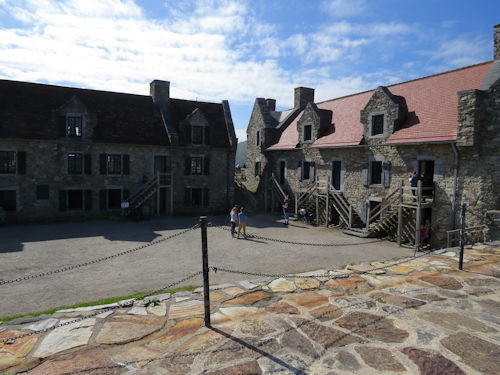
Today I chose to do a tour of Fort Ticonderoga. I hadn't been there since I was a child, and I really wanted to see it. The location was important in Colonial and Revolutionary times. Whoever controlled Lake Champlain and the waterway that basically connects the St. Lawrence River with the Hudson River controlled that whol part of the country. You can see the cannon mounted to face Lake Champlain.
fort ticonderoga


Some of the fort is original, and some is reconstructed. This is the inner courtyard.
fort ticonderoga


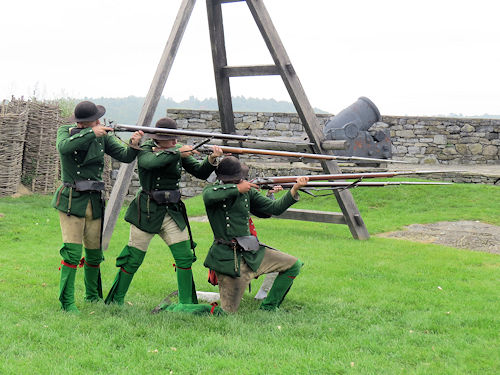
We watched a musket firing demonstration, with explanation of how the soldiers were organized so that they didn't shoot each other.
musket firing


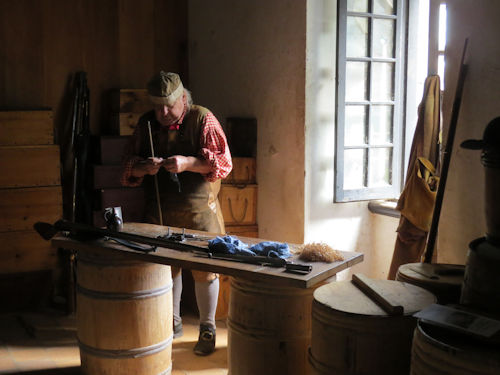
This man was demonstrating how the guns were cleaned after firing.
cleaning a musket


This is a morter. They were highly decorated, and the designs mean something, but I didn't have time to read all of what that was about. Apparently most of the artillery used was made in the Caribbean.
revolutionary war morter


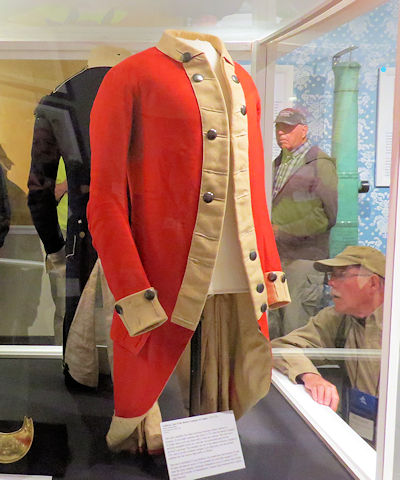
This is believed to be the oldest American military uniform in existence. It was made in 1772.
Colonial era uniform


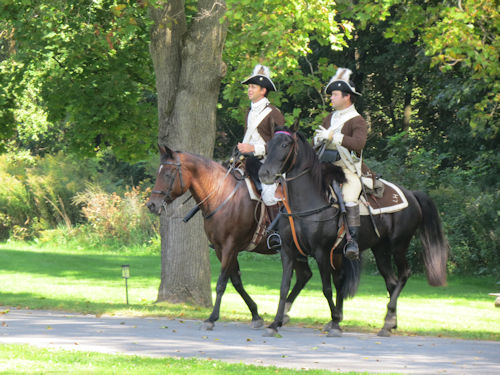
Finally for today, here are two horsemen who were patroling the grounds.s
Colonial horsemen


Gotta scoot to dinner. We did another fun thing too, but I'll have to share another time.

See Meade and Beckham