Entries to Win Afghan

Sign up to receive the Books Leaving Footprints Newsletter. Comes out occasionally. No spam. No list swapping. Just email me! jhyshark@gmail.com Previous gifts include a short story, a poem, and coupons. Add your name, and don't miss out!
Showing posts with label liverwort. Show all posts

Saturday, May 19, 2018

Bryophyte Fun- Liverwort Sex!

 
Here was another first for me (I think!). It sure was the first time I remember seeing this, and definitely the first pictures.

First of all, Bryophytes include mosses, liverworts, and hornworts. They reproduce by similar but odd means. What you see when you look at the plants are the equivalent of seeing eggs and sperm. I'm not about to try to identify this liverwort, but its one of the thallose ones (like a leaf, duh). These spreading "leaves" each have half the chromosomes of the plant.

liverwort with archegonia or antheridia

Some are female, some are male, but they all look alike until they grow these stalks. The stalks are what I don't recall seeing before. The heads in these pictures all look alike. I think if they were opened out more you could tell the male antheridia from the female archegonia.

liverwort with archegonia or antheridia

So the archegonia contain eggs, and the antheridia have sperm. These get together and produce a zygote with the full set of chromosomes. We're used to thinking of this as the "real" organism. You and I, and trees and puppies have full sets. But you'll never see the "real" liverwort unless you hunt for it and bring a microscope.

The zygote (fertilized egg) becomes a sporophyte, which spits out single-celled spores- once again with only half the chromosomes. The spores take root and grow into new little "leaves." See the small bright green "leaves" in the picture.

liverwort with archegonia or antheridia

Liverworts can also reproduce asexually, but no display of that this time. I've never gotten pictures of that either. There is lots to learn about bryophytes, even if I never manage to identify one with genus and species!

And, yes, ancient people thought liverworts were good for the liver. No actual medical value has ever been proven.

In other news: I wrote a chapter in The Bigg Boss, and got my Books Leaving Footprints newsletter just about ready to send. I'm just waiting to confirm a date. Put some stuff away.

See Liverworts
if you like this blog, click the +1   or

Like This!


Friday, April 25, 2014

A Hike Too (?) Early

 
I'm leading a hike next weekend that purports to be a "Fern Walk." I had to go past that area today anyway, so I took an abbreviated walk to see what was popping up. No ferns, haha. Not even little nubbins of growth, let alone a fiddlehead. There were some of last year's fronds on the evergreen varieties.

This area should have been sprouting with new fern fronds like crazy. Nothing. Well, nothing ferny. Lots of moss! And it's green.

boggy area

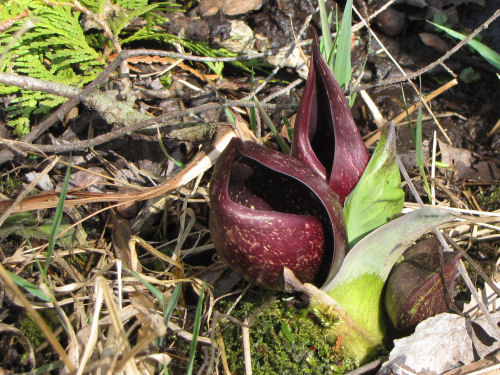
But I did see some evidence of plant life for this season. The skunk cabbage is a little wetter than it likes, thanks to all the rain last week. But it seems to be fine.

skunk cabbage

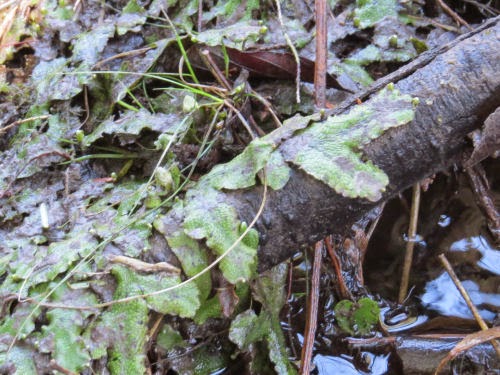
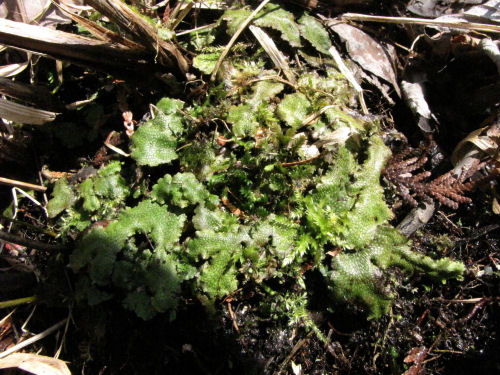
I have showed you liverwort a couple of other times. I don't know the different ones except that this is a thallose liverwort, which means it looks kind of like a leaf. I do think it's different from the other two, but looks can be deceiving. If you want to see the others, click "liverwort" in the labels at the end.

liverwort

This was a nice little surprise. I hadn't ever seen it along this path before. Just wasn't looking in the right places. It's Goldthread, Coptis groenlandica, which has bright yellow roots (the gold thread), and gets a pretty white blossom. It likes acid soil, telling me that this area is boggy.

goldthread

In slightly drier areas, I found bristly clubmoss, Lycopodium annotinum, although they change the Latin names of these "fern allies" every time you turn around. But this one is easy to tell. It looks like plastic, and the "leaves" point downward. And it grows with runners, not in clumps.

shining clubmoss
Here's one of my favorites! It's a horsetail, Equisetum scirpoides, dwarf scouring rush. But I love how it's curly. It's also very tiny as you might guess by the name.

dwarf scouring rush

Growing pretty much everywhere is partridgeberry, Mitchella repens. Very common to find it with wintergreen, and that's also everywhere. So common, I didn't even take a picture. Both are evergreen, so they are easy to spot in early spring.

partridgeberry

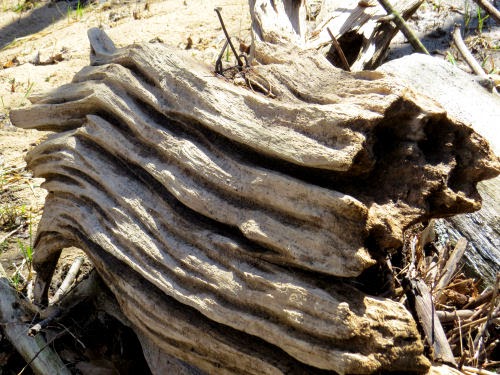
Finally, here's just a piece of driftwood along the river that I liked.

driftwood

Heard the first spring peepers of the year, and saw a fish (probably a steelhead) jump a foot out of the water!

I had to do a lot of work today, and this walk was less than an hour, but it was awesome!


if you like this blog, click the +1   or

Like This!

Tuesday, March 20, 2012

Flora and Fauna

 
The weather is defining our lives- of course it often does, but temperature records in March are getting shattered by 10-30 degrees every day this week. In some ways it's quite enjoyable, but there will be a lot of damage when we get an inevitable freeze. (The idea that we might not get cold again is really unlikely. We generally have a chance of freezing through May.)

Flowers are blooming and critters are out. These pictures are from yesterday and today.

First we have the ever-popular skunk cabbage. It might actually be expected at this time of year. This one is particularly handsome in deep purple.

skunk cabbage

However, the hepatica is about a month early. Last year's pictures show this blooming on April 25.

hepatica

I hunted hard, because I wanted to show Loren a liverwort, and I found a couple of patches! I've told you about this strange plant before. The "leaves" are one cell thick, and they only have a half number (haploid) number of chromosomes. I sure haven't even thought seriously about identifying different liverworts, but I think this is a different one from what I showed you before. (link at end)

liverwort

Today, I was lucky enough to spot some critters! Here's a sleek black squirrel. One might see them even through the winter.

black squirrel

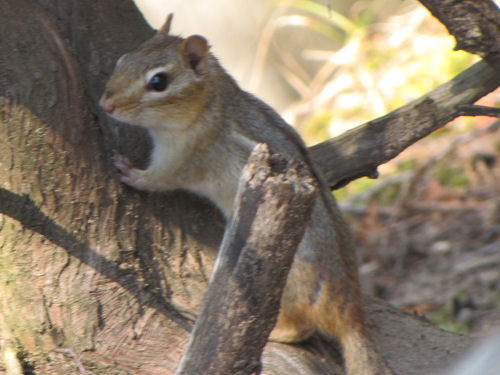
But here's another little Eastern chipmunk. Definitely not seen until the weather warms.

Eastern chipmunk

I also got some OK pictures of a sweet little bird, but I think I'll save those for tomorrow! Spring is here on the calendar, and on the ground- really strange in March.


See Ruffled for more liverwort
See Ruby Creek is Golden for hepatica
if you like this blog, click the +1  

Sunday, October 16, 2011

Ruffled

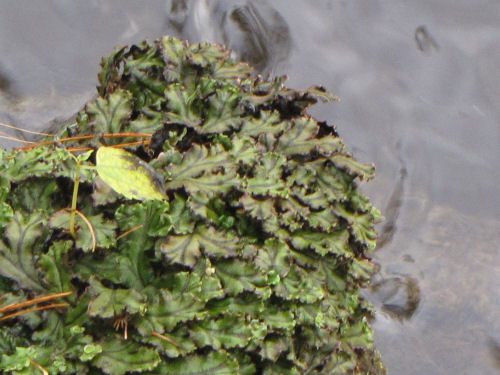
I'm not a fan of ruffles, unless it's these kinds. The first one is a liverwort. Liverworts are a biological oddity, in more ways than one! First of all, they are only one cell thick. Yes, each of those flabby "leaves" is like a bundle of twigs, with tall cells side by side. The "leaf" is called a thallus. It's more like a sperm or egg, because it only has half the genetic material of a liverwort. At some point little stalks will appear with a capsule on the top which has the full number of chromosomes.

liverwort

Next, we have orange ruffles. I don't know exactly what fungus this is- probably a polypore. I'll just stop rather than spouting misinformation.

orange polypore

Finally, I do know what this one is. It's violet-toothed polypore, most recently named Trichaptum biforme. It's really a polypore, but looks like a tooth fungus- hence the "biforme." It starts out bright purple, but quickly fades to this deeper purple and then brown to white.

violet-toothed polypore

Can't see the teeth? Let me help you.

violet-toothed polypore

See Treasures at Nordhouse for a different orange polypore
See Violet-toothed Polypore for a bright young specimen
if you like this blog, click the +1