Entries to Win Afghan

Sign up to receive the Books Leaving Footprints Newsletter. Comes out occasionally. No spam. No list swapping. Just email me! jhyshark@gmail.com Previous gifts include a short story, a poem, and coupons. Add your name, and don't miss out!
Showing posts with label salt-glazed tile. Show all posts

Monday, May 29, 2023

Road Trip!


Cathy and I took a road trip today. There was a specific purpose, but I'm not going to tell you what it was! There's a hint in the second link below, but it's related to some very good news. The news is that the Ludington Daily News is reinstating my "Get Off the Couch" column which was discontinued when Covid hit.

Here is where we began our adventure, on the shore of Lake Mitchell in Cadillac.
Lake Mitchell


It included the Manistee River near the middle

Manistee River


The day started out at a nice temperature, but boy was it warm by the time we got to the river.

friends


We ended at beautiful Traverse Bay.
Traverse Bay


The adventure included shady back roads.
shaded road


And.. pizza! I had been hungry for it, and Cathy said we should do it.
pizza


An incidental find was a house made of salt-glazed bricks. Although the process was discovered around 1400, it was not used on structural brick until the early 1900s. So this house is probably from around 1920. Salt glazing isn't done any more (on any kind of production scale) because it's environmentally unfavorable. You are more likely to see it used for silos than for buildings, but occasionally there will be a house or township hall.
salt glazed tile house


Before we headed home, we had to have some ice cream. Although the bay made it cooler right in Traverse City, it was in the mid 80s everywhere else. Hot.

ice cream


The day was not about hiking, but we did walk somewhere between 2 and 3 miles just incidentally. My LDN column will resume after I finish the hike, and Mason County Press is still carrying my articles too. I am all set with what I'll write about for the first one, perhaps two, entries.

The car is delivered to be fixed in the morning.

See Glazed Tile Silo
See Feels Like Home

Monday, January 12, 2015

Silo Tops - 2

 
Although I went out for a nice walk again today, nothing new caught my eye. However, I've been saving these pictures, so this is a good day to bring them out.

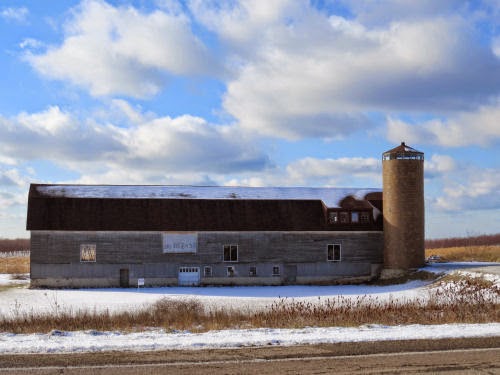
I pass this barn quite often, and consider it a bit of a mystery. In the first place, it's really big. That's not totally strange, but even in this agricultural economy, this one is large. It doesn't appear to be in use for farming any more.

large barn

The silo is salt-glazed tile. We have quite a few of those around here, so that's not too unusual, but this is set on a really old stone foundation.

salt-glazed tile silo

It looks to me as if at some time one portion of the upper area of the right end of the barn was made into an apartment, because of the dormer with residential-looking windows.

dormer on a barn

But here's the biggest mystery. Whoever saw a silo with glass windows at the top like an observatory of some sort? I've always wondered if they were added and the upper portion of the silo is part of the apartment. However, the windows don't really look sealed well enough for that, either.

silo top with windows

At any rate, it's certainly interesting.

See Glazed Tile Silo
if you like this blog, click the +1   or

Like This!


Friday, October 24, 2014

Antique Martin Steel Silo

 
Tuesday was a glorious October day and I found a different silo construction for our edification. This one is made entirely of curved sheet metal plates, bolted together. To tell you the truth, I don't recall ever seeing a silo like this, but surely this one is not unique. I've looked on line, and can't seem to find any information about this kind, however, the search results are overwhelmed with links to modern metal silos, so there could be something if I search harder. Obviously, this one is not new. The barn is probably 100 years old, given that it has collapsed.

historic metal silo

I thought the top was particularly interesting.

historic metal silo

The silo is made of curved pieces of sheet metal with lipped edges which are bolted together. Here's a view looking up.

antique sheet metal silo
I just had to get a little bit artistic. Well, I tried. There was too much breeze to get the grass to hold still. I was trying to get that interesting rust spot, the grass head and its shadow all in one view.

antique sheet metal silo

Now I have more questions. When I look at an enlarged photo of the connections between the plates it really looks like bolt heads. But that's a LOT of bolts. Isn't it more likely they were riveted? I need to take a picture of the underside of the connections which are in shadow in the pictures I have.

Thanks to some help from Vanilla, I have discovered that this is a Martin Steel Silo. We found pictures of them from Pennsylvania; Menominee, Michigan; Wisconsin; and Vermont. I'll have to do some more sleuthing.

It's a long way from home. I won't be going there any time soon, but maybe I'll have another chance. It actually wasn't too far from the Stone Silo.

See Concrete Stave Silos
if you like this blog, click the +1   or

Like This!

Sunday, February 24, 2013

Glazed Tile Silo

 
I love old barns, but so many of them are falling down. It's sad. Every farm had one or two silos. One of the types of silo that was commonly built in the 1920s and 1930s was made of glazed tile.

glazed tile silo

The whole point of this type of silo was/is to contain corn or grain in a semi-fermented state. The round shape prevents air pockets from being trapped in corners, and a number of different materials have been used to build them. Once the silo is filled, the contents begin to ferment and use up the remaining air. The silage can then be maintained at the same state, ready to feed to livestock.

Maybe I'll start a series on types of silos. In any case, the glazed tile ones are very attractive.

glazed tile silo

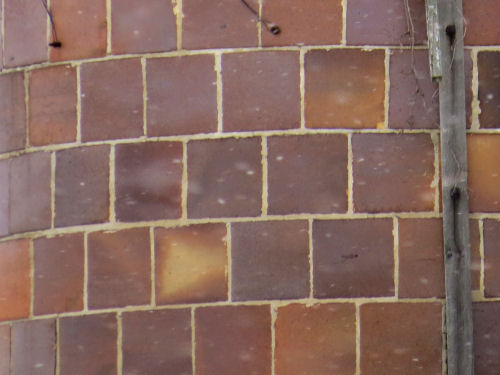
The tiles are what's called salt glazed. Salt is placed in the kiln during firing, and the salt vapor reacts with the silicone in the clay. This creates the sheen and the rich brown colors. The hard glaze makes the walls impervious to air and moisture. The blocks were generally hollow allowing them to expand and contract with temperature changes.

I thought I was going to show you a picture of a farm in good condition with two beautiful tile silos, but I can't find it, so perhaps some time in the future.

if you like this blog, click the +1   or

Like This!