Entries to Win Afghan

Sign up to receive the Books Leaving Footprints Newsletter. Comes out occasionally. No spam. No list swapping. Just email me! jhyshark@gmail.com Previous gifts include a short story, a poem, and coupons. Add your name, and don't miss out!
Showing posts with label learn something new. Show all posts

Monday, December 22, 2025

Chrismons


I learned something new this week! The white and gold ornaments on some Christmas trees have a name. They are called Chrismons- a portmonteau word of Christ and monogram. They are always symbols of the Christian faith. That much I knew.

Not being raised in a liturgical church, I did not know that white and gold are the liturgical colors of the Advent season.

Just to remind you, here is the Chrismon tree at the Lutheran church next door.

Chrismon tree


This type of ornament was first created in 1957 by a woman named Frances Spencer who made all the ornaments for the Ascension Lutheran Church Christmas tree in Danville, Virginia. She said the tree was not complete until someone had the story of Christ explained to them through the symbols. So... a truly US-based tradition that has spread to many denominations and throughout the world.

Here is a small Chrismon tree at the Ludington Methodist church.
Chrismon tree


I have some closeups of the symbolic ornaments, but not all of them are great pic. I'll highlight a few.

Symbols of the trinity are always featured. These have three connected circles (a trefoil), or a triangle, or both. They represent the triune God: Father, Son, and Holy Spirit.
chrismon of trinity symbol


The trees also have only clear or white lights if they have lights. You can see that some have strings of white and gold beads.

This picture isn't very good, but it shows a shell. This is the symbol of baptism (because a shell can hold water), the beginning of a journey (as baptism is seen as the outward display of a serious desire to follow Christ), and spritual growth. The ribs of the shell symbolize paths to spiritual truth. Actually, I'll bet a lot of you already knew this, even if you didn't know you knew it. The shell is associated with St. James (Iago), and the Camino de Santiago- the way of St. James in Spain- uses the shell as its trail marker and symbol. I know two people who have chosen to get a small shell tattoo as a reminder of their walk of the Camino.


Behind the shell is a star- a fairly well-known symbol of Christianity not only for the Christmas star, but as a reminder that Christ is the light of the world, and we are to be the light to others.

Various kinds of crosses are alwyas found. The cross, a Roman emblem of shame and execution, became the symbol of triumph for Christians as Christ rose from the dead. You'll find any number of styles of cross. This one has something hanging from the arms. The left one is probably Alpha, but the one on the right does not look like Omega, so I'm not sure what's going on here. Alpha and Omega are the first and last letters of the Greek alphabet. God and Christ are called the Alpha and Omega- the beginning and the end, a symbol of their eternal nature.
chrismon cross


If you look at the pictures of the entire trees, you'll also see sheep (Jesus as the Lamb of God who was sacrificed for our sins), doves (symbol of the Holy Spirit), circles (symbol of the eternal nature of God), the Chi Rho cross, which looks like a P with an X on the upright. These are the Greek letters chi and rho, a monogram for Christos- Christ in Greek.

Here is a crown- symbolic of our future reward in heaven, and that Christ is King.
crown chrismon


Some other symbols that may be used are the shepherd's crook (Jesus as the Good Shepherd), the butterfly (eternal life), the rainbow (God's promise to Noah), the chalice (symbol of the Eucharist), and the anchor (God is an anchor for our soul).

I don't see any fish on these trees, but this is one of the oldest of the Christian symbols IXTHUS means fish, and it's an anagram for "Jesus Christ God's Son our Savior." Early Christians would identify themselves to each other by scratching a semicircle in the dust. If the other person completed the fish, they know it was safe to talk of spritual things.

Of course, many of these symbols are now mocked or discarded. But I like symbols. A lot. I have several books on symbology. They are great as mnemonic devices, and they are sort of like puzzles in pictures. I'm glad I learned these ornaments are called Chrismons.

And here is another full tree- this one at the Methodist Church in Manistee a few years ago.

Chrismon tree


I got quite a lot done today. Hopeful for more of the same tomorrow!

See Concert at Our Savior Lutheran

Friday, December 19, 2025

Kitchen Puzzles


Well, I don't have too much to share today. This was the best moment. It wasn't quite truly a LOL moment, but I was so surprised I did grunt and say, "Ha!"

Om bought some chicken salad that was so sloppy with sauce he didn't even want to eat it. We pushed it through this strainer and got it reduced to a much better texture. When I turned it over (not sure why I did this- just to expose that side to water to clean it, I guess), this design became evident. It just tickled me because it was a surprise. Doesn't take much to entertain me, right? It looks like some kind of game maze.

Ignore dirty dishes behind it.


The other kitchen puzzle is that we got a cheap air fryer. We weren't sure, still aren't, how much we'll use it, so we didn't want to spend a lot for features that we don't care about.

I've used it about 5 times so far- trying to get better at understanding it. Pictured on the plate is a low-calorie cinnamon roll. I made a small pan to see if they were edible enough to have for Christmas. As mentioned before, Om and I are both attempting to not turn into blimps over the holidays. And I baked the pan in the new toy. New recipe and new appliance is a real puzzle. Could have been a total disaster.

Anyway, they aren't like wheat flour bread, but they are OK, so we'll have them for Christmas breakfast.


In other news- I worked at all the usual things.

See A New Kitchen Toy

Sunday, December 8, 2024

More Vermin Tales

 We no longer have a dog. I no longer have any toxic houseplants (maybe). I really have very few houseplants. I gave them all away before the big hike, only requesting that one of them come home. Two more have appeared since then, but one of those is now dead.

Well, I do have the succulents that came inside from the rock garden for the winter. Two of those are a variety of aloe, but I don't really consider those houseplants.

The mouse traps we had were getting tired, and the mice were continually stealing the bait without getting caught. So I bought new traps. Good traps. Caught seven mice in four days and the current population seems to be zero.

However, I've learned something this year. I've never had this problem before, but mice will burrow in houseplants. And they will bite them off.

See the hole beside the Christmas Cactus? At least this plant is still alive.
mouse hole in a houseplant


They plain old killed a plant Marie gave me this summer.

There are some plants that are supposed to be poisonous to them. Aloe is on that list. However, they don't seem to have noticed. The two aloe that I would like to grow large enough to put in the rock garden for the summer have been continually dug up and left lying on the top of the soil. Aloe are tough, but even they have limits. I have two small sprigs that are still alive. Barely.

I have not caught a mouse for over a week now, nor seen, nor heard one.

Do I dare fill in that hole? Last time I did, it was immediately cleared out the next night.

I have now read that I can put certain spices in the pots that will deter the mice. If they come back, I'll try that.

I love the cute little deer mice and hate killing them, but they have to agree to my rules that they stay outside-- out of my pantry, kitchen and plants.

In other news: I edited a LOT. I watched White Christmas because, well, I like Danny Kaye and Vera Ellen, and it's a sappy, feel-good Christmas story.

See Six Mice

Monday, November 4, 2024

More Plant Weirdness

 I think most of us remember from some earlier piece of education that things like mules and ligers which are hybrids between two SPECIES of related animals are sterile, or are not even viable. I was surprised to learn, today, that there are some examples of animal hybrids between two different genera. Fish seem to hold the lead. But they are rare.

I suspect the takeaway from this is the reminder that the categories are imposed by humans who attempt to organize the world. And to remind us all, taxonomy is an ever-shifting discipline. Especially now that DNA testing is being used to recategorize things. Previously, the groupings were done almost exclusively on morphology, that is comparing the structures of one living thing to another. For example, in plants, are the flowers or seeds of this plant basically the same as that one? But the DNA is providing lots of surprises, showing that two plants not thought to be related are sometimes very close siblings!

But plants like to be weird.

For example, most of the wonderful Sunsparkler sedums I've been raving about are a cross-GENERA hybrid. They are mostly crosses between Sedum and Orostachys-a different kind of succulent. Techincally, this "new" genus is called xSedoro. All cross-genera plant hybrid names start with an x like that.

As a reminder, here's one of my fav SunSparklers. This is 'Dream Dazzler'

dream dazzler

Crossing genera in plants is done fairly often. These two are xGraptoveria which are crosses of the genera Echiveria and Graptopetalum. The first one is called 'Ivory.' As you can see, they are blooming, but I don't know if they produce viable seeds.
ivory graptoveria


This is another xGraptoveria, although I do not know which one. I think this one is pretty cool, with the broad purple leaves.
graptoveria


I tried to find out how many genera crosses there are for plants. I found a list from the UK that is 94 pages of small print, and it doesn't even have several that I know of on it. As you might suspect, a LOT of them are dealing with orchids. Orchids have been tinkered with for lots of years..

Well, I slept late big time this morning. Not sure what that was about. Then I spent most of the day editing. I have two big jobs I'm working on. Wrote Chapter 31 in Vacation from DMS, which is 723 words. A little short, but it's where I want the break.

See Sunsparkler Sedums

Wednesday, February 28, 2024

Where My Linguistic Interest Began

 I'm reading another book about linguistics. This one is even older than the book referenced in the link at the end. I'll tell you what I'm reading in a minute.

However, I think I can safely say that this is the book where my interest began. Rudyard Kipling's Just So Stories (1902). This is the edition that I had as a child. Do you know them? They are funny make-believe tales like "How the Elephant Got His Trunk." (the crocodile kept pulling on his nose). Or "The Cat Who Walked by Himself." (how cats are always independent and don't want to be friends like other animals). This was one of my favorite books as a small child, which is interesting, because I was an extremely literal and serious child, but these stories are funny, and I did understand that.
Just So Stories


One of the stories is "How the Alphabet was Made." It's a fanciful tale of a girl named Taffy who starts to create drawings of sounds that her father makes. The thing that makes it silly is that they are making shapes that would make sounds that we use in English. But it starts with "ah," and Taffy watches her father make the ah sound and decides that his open mouth looks like a carp, so she draws a carp mouth pointing downward because they are bottom feeders. Her father suggests that she put a line across it for the carp's feeler so people would know it was a carp and not a trout or a perch. They ended up with this...
the letter A as a carp mouth


Which turned into this... A
the letter A


OK, even as a preschooler I somehow knew that this was silly because nobody who lived that long ago was speaking English and using the Roman alphabet (my mother taught me the Greek and sign language alphabets right along with English). And yet, that is approximately how the early picture languages evolved into phonetic languages.

So yesterday, through reading another fiction book, I found another linguistics book, The Story of Language, by Mario Pei, written in 1949.
The Story of Language


I probably should find something on the topic that is more recent, but it's still a lot of fun.

He talks some about the pictographic writing morphing into ideographic symbols with meanings beyond nouns. For example, in Chinese the symbols for sun and tree were combined to mean "east"- the sun rising through the trees.

Or how the Egyptian symbol for the sun, and the sun god Re, easily transformed to the phonetic character for the re sound.

He says the Phoenicians (which I knew), and the Hebrews (I did not know this) were the first to transform symbols to exclusively phonetic values. Here is the Phoenician alphabet... if you know the Greek capital letters, you will see the obvious similarity.
Phoenician alphabet


And the Hebrew (read it right to left). Aleph began as a picture of an ox, beth was a picture of a house- the Hebrew word for a house is beth. (Beth-el= house of God)
hebrew alphabet


He also says that we only hear about 50% of sounds produced by a speaker which is why context is so important. And for a more contemporary example, part of why we had so much trouble understanding each other when we all wore masks during Covid.

I edited, I wrote about 1000 words, I did some other stuff.

See A Bunny Trail to Treasure

Sunday, September 3, 2023

Yipi, I'm in Ypsi


I am on my way, and my first stop is in Ypsilanti where I am spending the night with friend, Cindy. Wow! The last time I saw her was 2018. That's crazy. We are featuring the butterscotch chocolate chip cake she made for dessert.
friends


After dinner, we took a walk around the block. It was just the right length. One garden had these huge pink hibiscus. The flower is almost a foot across.
pink hibiscus


We walked through a friend's garden on the way. He must spend a huge amount of time working on this. It's a lovely mix of perennials and annuals.
flower garden


flower garden


I even got to learn something new. I did not recognize these seed pods. It's Clethra, sweet pepperbush or summersweet, probably Clethra alnifolia, a plant I did know, because it's a native wetland shrub. But I'd never seen it at this stage. A wetland site I worked on once planted some of these for landscaping becauase if you picture flower clusters where those pods are you will realize that it has long spikes of fluffy flowers. Really a beautiful shrub, and native. But, for some reason, they weren't happy, and they died, so I never saw the seed pods. Now I know!
clethra seed pods


In other news, the last job I did before leaving home was to trim the birch tree and clean the gutter. It's really not a hard job, but I kept putting it off.


Cindy and I will have most of the morning together, and then I'll be off on the next stage of the journey.

See A Day with Cindy

Friday, September 1, 2023

Acorn Plum Gall


I did not find this, but a friend did, and he asked me what it was. A little searching determined that it is the Acorn Plum Gall caused by the Acorn Plum Gall Wasp, Amphibolips quercusjuglans
acorn plum gall


Each ball is about 3/4 - 1 inch in diameter. I suspect it gets the name from the purpleish color. You can see the collection of various-aged galls that Fred made.

The clincher for the ID as a gall was when he cut them open. That round center with the radiating rays is characteristic.

I checked where in the world this particular gall is found, and sure enough, it's been noted here, so I think that clinches it.
acorn plum gall


The little wasp that lays an egg in the plant tissue which causes the tree to produce the gall is tiny and never bothers humans. Interestingly, this gall is only found on oaks in the red oak family- the ones with sharp points on the leaf tips.

Photo credits to Fred Hayward.

In other news. I have the workshop program pretty well done, and started on another editing job. That one will go with me.

See Oak Apple Gall
See Succulent Oak Gall

Saturday, September 18, 2021

Eastern Leaf-footed Bug Nymph

  Our first evening at the campsite in the Adirondacks in August we encountered several of these very strange insects. Eastern Leaf-footed Bug

The thought briefly crossed my mind that the thickened legs looked like a leaf-footed bug, but I couldn't wrap my head around the very strange warped shape of the body. Eastern Leaf-footed Bug

Bugguide.net to the rescue! This is indeed a leaf-footed bug. The Eastern Leaf-footed Bug, Acanthocephala terminalis, but it is one of the nymph stages. I looked up some of those stages, and earlier ones are lighter colored, so this is probably a near-adult. The adults are rather plain brown, but they have yellow/orange tips on their antennae. The nymph is much more interesting with that fan-shaped back end trimmed in white pinking. They do not bite. Eastern Leaf-footed Bug

In other news: I did laundry, I made yogurt, I emptied the trailer. Blah, blah.

See Western Conifer Leaf-footed Bug

Sunday, August 15, 2021

Bicolored Sweat Bee

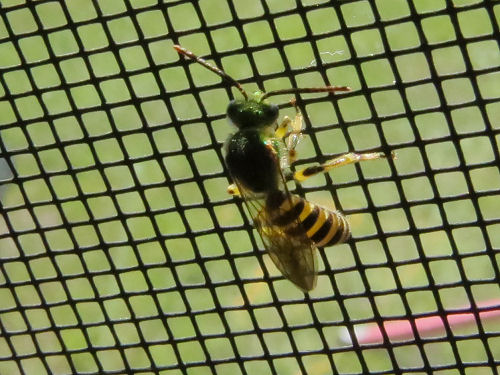
  Best find of the day was this little sweat bee that was trying desperately to climb through the screen and get out of the trailer. I helped him safely leave. You can tell how small he is when you realize that's ordinary window screen.

The last time I showed you sweat bees, it was really hoverflies. This one, however, is a real sweat bee. Today I learned that most sweat bees, family Halictidae, have metalic bodies. This one only had a green thorax, and the color didn't show very well in the pictures I took. It flashed bright lime green in the sunlight. The abdomen is yellow striped.

This is probably Agapostemon virescens, the Bicolored Sweat Bee, because there aren't many that have different colored thorax and abdomen. sweat bee

I'd really like to show you something on the trailer, and believe me, I worked my tail off. I stayed up half the night (and then couldn't sleep most of the rest of it). Worked all day long. Made really good progress on three projects, but nothing is ready to show you yet. And, I managed to do a little bit of editing.

Shower and bed coming up. I'm beat.

See The Sweat Bee's Secret

Wednesday, August 4, 2021

My First Two Pours

  Well! This is something I've wanted to try for a long time, and I got hit with an inspiration just before bedtime last night. Of course. So I was awake till 5 am watching videos. I learned a whole lot of different things. Possibly the most important one to me is that you can actually do this without spending a ton of money. You can mix the paint medium (which helps the paint flow and to dry without cracking) from Elmer's glue, rather than paying $50 a gallon for it. You can use latex house paint for your background color to keep the cost down.

Of course, there are lots of spectacular results out there, some REAL art, done with expensive acrylic paints that have intense colors.

But I was willing to give it a try with the cheaper products and acrylic paint from wherever. I have quite a bit, and I only bought one more color to play with. Eager to give it a try!

For those of you who say you never use math in real life, ahem... there was quite a bit of math involved in figuring out how much paint you need for any given project, and then the proportions to mix the medium to water to paint. Anyway, I finally had a couple of boards sanded and paint sealed and their square inches calculated. This technique is usually done on canvas, but my ultimate goal will involve wood (I know I'm being mysterious), so I want to experiment with similar materials.

Then I got all the colors mixed with the right amount of medium. Of course, you don't want to mix too much and waste a lot of paint. I figured I'd have to do at least four experiments before I could get anything I was happy with. Here's my first try.


And this is my second. I like them both a lot, but the second one is more the look I was going for. Can't believe I came close on only the second try! I might do a couple more. Maybe one for sure. I want to try adding in a metalic color. I have just a little paint left that probably wont keep past tomorrow, so it would be good to play with one more experiment.


I've left both of these pictures large, so you can click them and see the larger image. Did I say I'm REALLY happy with these?

In other news: I wrote a chapter this morning, then did yet another store run, and worked on the trailer and these "tiles." I have a meeting this evening.

table> See Resin-ating

Tuesday, August 3, 2021

Resin-ating

  What I have to show you today could be classified as fooling around, experimenting, practicing, trying to learn the pitfalls of something I've never done before. So it was fun, but it has a purpose. Yes, it's related to the trailer project.

Of course the whole prooject part of the day started with the usual unsatisfactory shopping excursion. Among other snafus, I thought I wasn't going to be able to get the resin locally. The place I was told carried it has discontinued it. However, I made some phone calls and found it in Ludington.

Here's what I did. I cut two 4" squares of plywood (not very straight, but it doesn't matter too much for this), and sanded them pretty well. Then I painted them with some white paint I had on hand. Hey, you've seen it before! It's the gallon I still haven't used up from the undercoat on the well pit project. (Here's a bunny trail about that paint. I got it at the Habitat Re-store a few years ago for only $5 a gallon. When I first used it, I learned why. The smell is SO bad I couldn't stand being anywhere near that room for several days. But using it outside isn't too bad.)

So, I painted these blocks with the white as a background color. painted blocks

When that was dry, I started fooling around with acrylic paints. Not really trying to do anything in particular, just making patterns. Here's what I ended up with for now. painted blocks

Then came the experimental part. I'm learning how to do poured epoxy resin. This is the first thin coat. Unfortunately, you can't really see much difference in the picture without the resin and the picture with. When it dries, I'll be able to get a different camera angle on it that will show it better. Anyway, I got a start on learning how to work with this. painted blocks with resin

In other news: I edited hard all morning, and managed to finish one part of a project. Then it was shopping, and when I got home I worked on the trailer - not ready to show you that yet, and did this resin. That took up the whole rest of the day. Nothing is done, but I made progress on several pieces of the puzzle.

See Paper Mache

Monday, August 2, 2021

Yarrow Tea

  Today, I tried the Yarrow tea. I remembered that this was a possibility when I was kneeling in the weeds to get the pictures of the Yarrow two days ago. The crushed yarrow leaves were highly aromatic, and I had never known that. Even more strange is that they have a scent similar to the plants in the genus Santolina, which I think smell like the first aid cream, Desitin.

This is a little weird, because Desitin is made from zinc oxide and cod liver oil. The chemical in the plants that has an odor is a terpene. There are thousands of terpenes, but they all have the formula (C5H8)n. That means they are carbon rings with attached hydrogens and the "n" refers to how many of them are strung together. The scents of pine and balsam and chrysanthemums are terpenes. I'm pretty sure cod liver oil is not a terpene.

Anyway, I broght home three feathery leaf stalks and dried them. yarrow leaves drying

A really knowledgeable plant person once told me that many plants can be eaten fresh or dried, but you shouldn't eat them in the wilting phase. Something to do with chemical changes, but I don't remember what. So I let them get nice and dry. Then I crumbled them into a powder with my fingers. dried yarrow leaves

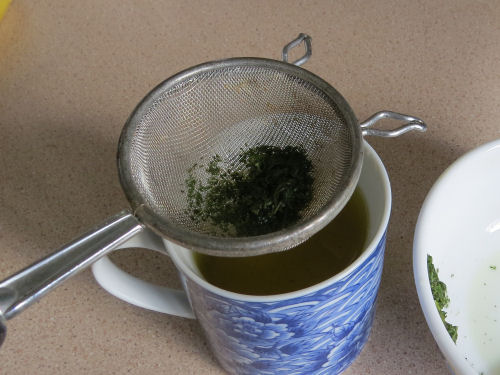
I did pull out the stems because I read that the tea can be bitter, and I thought maybe that would help. Then I steeped the leaves in boiling water. This demonstrates another use for the plants. It is used to make dyes. Apparently you can get either green or yellow colors depending on the mordent used. yarrow tea

Then I just ran it through a strainer to remove the leaves. The strength was about right. I was pleasantly surprised. It was pretty good. The list of ways this is supposed to be healthy goes on and on and on. I do think natural foods have value, but I find it unlikely that all the claims that are made for most any plant can all be true. But it probably has some benefits.

And it wasn't bitter at all. I would say that if you want to try it, crush some leaves first. It tastes pretty much how it smells.

Would I do it again? I would. If I am walking down that way, I might bring home some more leaves. I'm likely to find them most anywhere, but there are enough on that corner that it would be easy to pick enough to be meaningful. yearrow tea

In other news: I edited a lot this morning. I was hoping to work on the trailer, but the area I was fibergalssing did not dry from the morning dew until this evening. I got one more layer on. All the rest of the time was spent doing some volunteer stuff that was overdue.

See Yarrow and Friends