Entries to Win Afghan

Sign up to receive the Books Leaving Footprints Newsletter. Comes out occasionally. No spam. No list swapping. Just email me! jhyshark@gmail.com Previous gifts include a short story, a poem, and coupons. Add your name, and don't miss out!
Showing posts with label botany. Show all posts

Tuesday, September 2, 2025

A Few Prairie Plants


I tried to do some on-the-fly botanizing in North Dakota and saw some familiar plants and learned a couple of new things.

This one I knew, but I'd never seen so much of it in bloom naturally. This is Stiff Goldenrod, Solidago rigida. The leaves and stems are very... stiff.
stiff goldenrod


Here's another one I knew, but I'd never seen it when the berries are this ripe. It's Snowberry, Symphoricarpos either occidentalis- western or albus- common. It's an important food for wildlife. They will give humans a stomach ache, being mildly toxic.
snowberry


I've always seen Gumweed in bloom. It's a common roadside plant in the prairie. This is probably Grindelia squarrosa, Curlycup Gumweed. Looks similar to a dandelion from a distance, but up closer you can tell the leaves and stems aren't like dandelion at all, and the flowers have a central disk as well. Yes, they feel sticky.
curly gumweed


Lots of this tree was planted in North Dakota as windbreaks. It's not as invasive as our Autumn Olive, but it's not great. This is Russian Olive (or Silverberry) with the fruit. And you can easily see the difference in the two plants at this stage. The Autumn Olive berries are round and red. These are olive shaped, and although they will turn orange/reddish, they don't look anything like the others. Elaeagnus angustifolia is the name, which is another clue. Any plant with "angustifolia" in the name has narrow leaves, and these leaves are longer and narrower than the Autumn Olive.
russian olive


Now for my best botany find. This is completely new to me. WINNER! This is Silver Buffaloberry. It's related to the olives, all in the family Elaeagnaceae, But this is Shepherdia argentea. The berries were ripe. The Native Americans gathered them to pound into meat with various other things to make pemmican. I had to try them.

YUM! I did learn that a lot of locals just shook their heads and said "no thanks." Web sites say they are bitter. I found them to be more tart, like wild currants. I ate quite a few! It's a small tree, also with white leaves. (Note "argentea"- silver - in the name.) They would make a yummy jelly or sauce to use with meat.


No new plants at home, but I found something very cool this afternoon that I'll probably show you tomorrow.

Kept busy all day- computer stuff, editing, picked up my sales stuff from the people who carted it home for me from Paradise, sorted books, ordered books, prepped for Saturday, blah, blah. Busy day.

See Silver/Gray Plants

Thursday, October 3, 2024

You Say Chasmogamous and I Say Cleistogamous

 The super quality of today comes from learning something completely new. I'm pretty sure this is not a case of my simply forgetting something I learned a long time ago. I'm totally blown away.

I couldn't stop thinking about the five-part violet flower having a three-part seed pod. Things in the mustard family have four-part flowers (four petals, four sepals, four part ovary, four-sided pods). Tulips and juncus have six petals, etc, which fuse into a three-sided seed pod. But five to three just doesn't compute.

I didn't really get the answer to my question. I thought maybe the lower petal, the "lip" was two fused petals such as in snapdragons, but that doesn't seem to be the case. (I suppose there doesn't have to be an answer, it just "is"). But I found out a whole lot.

Remember those little closed pods I showed you yesterday? I brought a few inside to look at more closely. Here's one.
violet cleistogamus flower


Well, it turns out that the violet (and some other plants) produce two kinds of flowers. This is a cleistogamus flower. Huh?

First, let's sort out those big words. We already almost know them. We know monogamous and bigamous and polyagmous. Yup... all referring to a type of marriage. Well, it seems there are two more words in this series. Chasmo- is open, and cleisto- is closed. I will try to remember this because cleisto- sounds like cloister (not etymologically related), and chasmo- sounds like chasm, an open yawning gully (these are etymologically related). So chasmogomous flowers are open to pollination from anyone! These are the big, showy purple flowers we all know and love in violets in the springtime.

Well, in a plant, promiscuity can be a good thing. It leads to genetic diversity and strengthening of the population.

Now let's take a break from the big words and look at that little "pod" again. The little green pointed things that look like leaves are the sepals. And there are five of them, as you would expect from a plant that has five petals. If you rotate this, you see there are three sepals that are larger and wrap around to the stem, while two of them are smaller and lapped to the inner layer. In this picture you can see two of the larger sepals and one small inner sepal.


Those two inner sepals do not become major divisions of the pod. Looking at the end, you can clearly see there are three sections.


But, jumping Jupiter! This is not a seed pod. It's a cleistogamous flower. That means it's closed. As in completly closed. It never opens; it self-polinates, and is not even monogamous. More like a hermaphrodite. Some plants produce cleistogamus flowers in the fall, and violets are big on the activity. The process takes fewer resources than growing petals, necter, or large quantities of pollen. They insure reproduction even if slugs or rabbits eat all the pretty flowers, or someone mows the lawn.

Furthermore, these violet seed pods dehisce, which means they open violently and fling their seeds out into the world. In fact, this was closed when I brought it in the house but it split into that pinwheel in just a few minutes.
common violet cleistogamous seed pod


The next stage is the pinwheel full of seeds that I showed you a couple of days ago.

Now, I'll have to watch for the chasmogamous seed pods in the spring.

I worked on necessary stuff, punctuated by weeding the rock garden all day.

See Common Blue Violet's Promise

Monday, February 8, 2021

Blueberries in the Snow

  Haha- you didn't think you'd be seeing BERRIES in February, did you? What I want you to see is that you can easily tell our two common blueberries apart, even in winter.

The really short ones- usually under a foot tall, and barely poking through the snow last week are Lowbush Blueberry, Vaccninium angustifolium. I once told someone this scientific name, and got the response "Geshundeit!" lowbush blueberry plants

But also growing profusely in our area are a taller blueberry. These bushes are generally about two feet tall. I'm pretty sure these are Vaccinium pallidum (formerly V. vacillans. You can tell they are much more shrub-like than the short ones. This one has several common names: Blue Ridge blueberry, or hillside blueberry, or confusingly enough- late or early lowbush blueberry. I suppose this is because it is shorter in relation to highbush blueberry (the cultivated ones at blueberry farms), but it's clearly taller than the one in the top picture. Blue ridge blueberry plants

I learned today that there are at least 28 recognized species of blueberry! (they don't all grow in Michigan) I don't know if you can distinguish any of them by taste, but I certainly can't tell these two apart by their flavor.

Enjoy a picture from their fruting season! blueberrier

In other news: I shoveled more. I actually got out of the driveway, and more to the point, back in again after I went to the bank. I participated in an on-line book promotion event this evening. (You can sign up for other readings in many genres throughout February at Pages Promotion)

See Dead Horse Marsh in Winter

Saturday, November 14, 2020

New Toy- Not Quite

  I've been keeping you in suspense about my new toy. Well, here is it, and here it isn't.

I bought a digital microscope that will take pictures. I want to use it for seeds and other plant parts. This is not a high quality one, but it's not the cheapest one either. It doesn't have quite the clarity I would like, but it's pretty good. And I could afford it. digital microscope

The first big problem was that it didn't come with the micro SD card. So, no big deal, right. I even had an extra one. But it wouldn't snap in place. So, I read the fine print and it specifies a particular kind of micro SD card. I could not buy it locally. Had to order it. Second big problem: It won't snap in either. I guess there is something wrong, and I'll have to send the scope back for replacement. Sigh.

I wanted to show you the next seed today. Well, I will. But I had to take a picture of the screen and of course all the interference lines and color cast show up when you do that. Until I can get this replaced, you can guess at what kind of seed this is. magnified seed

In other news: I took a 4-mile walk. I wrote chapter 8 in Dead Mule Swamp Singer for a total now of 7664 words, 799 of them written today. And I finished editing one of the MS I'm working on for other people. Not bad.

See Seeds- Spotted Knapweed

Sunday, November 1, 2020

Seeds- Spotted Knapweed

  Might as well pick another super easy seed to look at. This invasive plant is everywhere in our sandy soil. Spotted knapweed, Centaurea stoebe (formerly C. maculosa), has some beautiful relatives. This Centaurea isn't beautiful. Here's the summer view. Maybe you like the color, but the flowers are straggly and far apart on spindly stalks. It lends a purple cast to a field of grass, but that's about it. spotted knapweed

All the Centaurea look something like this with a vase-like ovary beneath the petals. I've seen some beautiful species in New York. I've tried to grow one of the garden varieties with large blue flowers. But, all I get is spotted knapweed. It's such a weed because it's so very successful. And it produces chemicals which tend to prevent other plants from growing (allelopathic).

The common name of spotted knapweed comes from the dark tips on the sepals. See the bargello-type pattern on the structure below the petals? The whole flower looks somewhat like a thistle, but it is not prickly and doesn't have spines. spotted knapweed

Right now, my yard is covered with the dried stalks. I have no trouble identifying the seed pods of this plant! spotted knapweed seed heads

Each head looks like a little vase with curly petals. Those are the sepals with the spots in the earlier picture. So what's inside? I had never looked before. New stuff to see! spotted knapweed seed case

In this case... nothing. The first one I looked at under the microscope showed only a smooth deep cup inside that is empty. spotted knapweed seed case

This is more like it! All kinds of hairy-ness going on in this one. spotted knapweed seeds

I teased the hairs out, and attached to little groups of them are the seeds. Each one is about 5mm long with the seed and the hairs (called the pappus). spotted knapweed seed

The pappus allows the wind to catch the seeds when they are released from the case. Plenty of them succeed in growing. The plant is a biennial with a long taproot. If the ground is soft, you can usually pull the whole thing out. But it's just as likely to break off and then it will just re-grow. spotted knapweed seed

This plant is right up there with autumn olive on my hated plants list. But it's too pervasive to really get rid of. Even most livestock won't eat it. Talk about low. I've read that sheep will eat it... if they are penned up with it and have no other choice.

In other news: The weather was nasty- bitter cold, strong winds and occasional snow. Nothing that will stick around here yet. So I stayed inside and made up sentences. I actually have 2147 words written in Dead Mule Swamp Singer. But I'm feeling some internal pressure to goof off. I need a good book to escape into. I'm beginning to feel put out that the library isn't open yet. You can order books and they will bring them to the curb for pickup, but no freebie pile to trade from, and no browsing the shelves.

See Seeds- Queen Anne' Lace

Saturday, October 24, 2020

Palynology

  I had to get about 3/4 of the way through the Forensic Botany book before I got to new-to-me material. The science of palynology is the study of pollen and spores. It can also include other microscopic plant parts.

So, botanically, I know the difference between pollen and spores. But would I know the difference if I saw them under a microscope? I wasn't sure, so I went hunting for pictures. Under a light microscope you can go up to about 1000x on a really good one. This is one kind of pollen. pollen at 1000x

Here are several kinds of pollen under a Scanning Electron Microscope (SEM). This is much more interesting, but not everyone has a spare SEM in their back bedroom. I don't even have that good of a light microscope. I can go up to 400x. pollen under SEM

Pollen has a super-tough outer shell, and an inner wall which contains two cells- the male gamete (a sperm cell- yes like a tiny polliwog just like in animals), and another cell that grows into a tube. When the pollen comes to rest on the female stigma of a plant the tube grows and the sperm swims down it to fertilize the egg.

Spores, on the other hand, are quite different. Here are some spores under a light microscope, but they don't really look too much different from a pollen- not all pollen is round. This could be tough. It's hard to get a high enough resolution. And both spores and pollen tend to be dessicated when you collect them in the wild, so they have to be washed in alcohol to remove a natural waxy coating, and then treated to make them plump up like a raisin. spores at 1000x

Under the SEM, you can tell more about the shapes of the spores. There are only a couple of basic shapes. The upper picture is a kind of spore that has been packed side by side with its neighbors, giving it a folded, bean-like shape. The lower picture shows a kind that were packed together tetrahedronally (like a pyramid). You can see that they retain the shape of those close quarters. spores under SEM

Spores don't behave much like pollen, except that they both result in a new generation of plant. A spore will grow into a little triangular leaf when it is given the right temperature and moisture. This is called a prothallus and it's actually more of an adult plant than the thing we call a fern, because it has both male and female parts like trees and flowers and grasses do.

The surface of the prothallus (pre-leaf, literally) will grow tiny root hairs, and two kinds of structures, each with half of the chromosomes (analogous to sperm and eggs). The sperm (sometimes cute little curliqueus) then swim from the antheridia to the archegonia, and fertilize the egg. Then it grows into what we recognize as a fern.

Would I know enough to recognize kinds of pollen or kinds of spores out of the context of the parent plant? Absolutely not. But there are whole image libraries dedicated to providing this information. A lot of times, the exact species cannot be determined with visual comparison anyway, but a family or genus might be identified. Actually, sometimes even plant DNA testing can not get closer than a genus. At least at the current state of the technology.

So, the quality in today is that I learned a whole lot.

In other news: I did a bunch of accounting stuff.

See My Crack (erjack/pot) Brain

Wednesday, August 19, 2020

Huckleberry Bog - Day 3

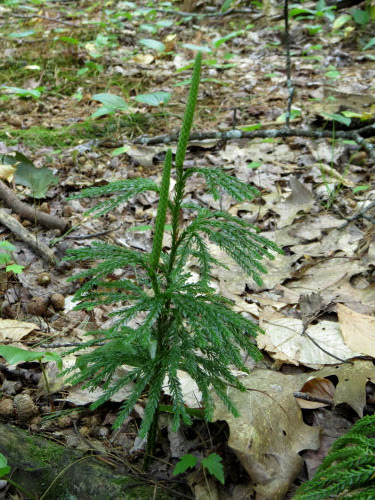
  Today I finished the in-the-field pictures and notes from the Huckleberry Bog Trail. It took me almost exactly the same amount of time as I spent on the first half. (Five hours of just botanizing, not counting walking in and out.) Not that it matters. I just thought it was interesting. This is a picture of the bog itself. It's really filling in with plants, but you can see one black spruce, typical of an acidic bog, growing in the middle. Huckleberry Bog I loved this fallen tree, and the green light twisted tree branches There were several kinds of club mosses. This is tree clubmoss, sometimes called princess pine, and various other names. It also has several scientific names, since the DNA testing is rearranging all of these genera. It used to be Lycopodium obscurum. I like this picture because I got the strobilus (the thing at the tip where its spores are produced) princess pine The bog is within Urbana State Forest, and this particular area used to be a homestead. Here is part of the house foundation. You can just see some layered stones making part of a basement wall. old house foundation The barn foundation is better preserved. It was a bank barn, and here you can see the lower wall in the foreground, and the wall that was beneath the bank in the background. old barn foundation Distance walked- at least 5 miles, but again, there was lots of wandering, and exploring, and back and forthing. I tightened up my knowledge of a few ferns, and hope to begin to learn how to tell shagbark from bitternut hickory when I compare my pix with the field guide tomorrow.
Tomorrow will be another semi-chill day as I work to label the pictures for the rest of this project and finalize my notes. 

See Huckleberry Bog Day 2

Monday, August 17, 2020

Huckleberry Bog - Day 2

  If you were wondering what happened to day 1 in Huckleberry Bog, it was swallowed up in the day we also stopped at Evageline Shelter. Huckleberry Bog nature trail This is an approximately 2 mile stretch of the Bristol Branch which also has a return loop so it can be hiked as a round trip. My friend Irene (where I am now staying), and a high school teacher and class, and the naturalist from Letchworth State Park worked together a number of years ago to develop an interpretive booklet and numbered stations. What they produced is quite extensive, and a real resource for teaching. Or, it can be enjoyed more casually by anyone. number tag on tree However, plants have a nasty little habit of changing over time. It's perfectly natural. The light changes, or the water table, and plants decide then don't like where they have been growing and die or go dormant. Plants die and others take their place. They grow and shade out other species. It's only nasty if the humans have done a significant amount of work to try to tell other people where they are by means of a booklet.
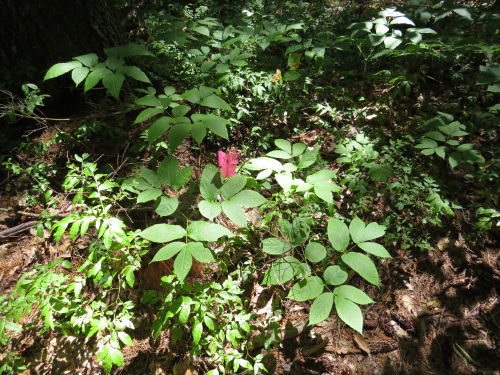
Irene was pretty unhappy to hear how much the plant communities have changed since the booklet was developed. She was wondering where she was going to now find someone who knows enough of the plants to check everything. Then we realized that I was wanting a project to do after Marie and I finished hiking, and I have the knowledge to be able to do this. There you go... it's what I'm doing now. So, today I spent a lot of time checking the text of the booklet against what plants are still around each number tag. I added some markers to others, such as this one for Sarsaparilla. sarsaparilla I won't bore you with a five-hour botany lesson (how long I spent on about one mile of trail). But I do have some cool pictures. This is a fungal pattern on Yellow Birch bark yellow birch bark This golden fungus adorned the base of a tree. Not sure what it is. yellow birch bark This is an American Chestnut. There were hundreds of sprouts in this woods, trying hard to make a comeback. Maybe one of them will succeed, and be the forerunner of the genetic winner that will allow the species to overcome the Chestnut Blight. They usually only get a little larger than this one before they die.
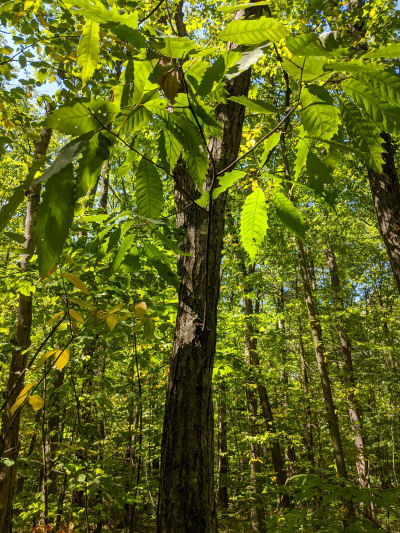
American Chestnut

Finally, I'll leave you with a little red eft. He wasn't as bright orange as some, but they always make me smile. red eft I got half of the sites checked today. I'll need to spend one more day to complete the semi-inventory. (Not a scientifically conducted inventory, but a better-than-casual attempt.) And it will also take about 2 days to get the data collected so Irene can use it to have the booklets remade.

So, you'll see more of this area. It's where the "hugging trees" are located. They are a man-helped anomaly, but it's always a treat to find a small area with such diverse plant populations. Really a nifty place. 

Miles walked? Not too many, except there was a lot of back and forth, and wandering around. At any rate, I'm beat for today. 

See American Chestnut in Michigan
See Bristol Branch - Evangeline