Entries to Win Afghan

Sign up to receive the Books Leaving Footprints Newsletter. Comes out occasionally. No spam. No list swapping. Just email me! jhyshark@gmail.com Previous gifts include a short story, a poem, and coupons. Add your name, and don't miss out!
Showing posts with label goldenrod. Show all posts

Tuesday, September 2, 2025

A Few Prairie Plants


I tried to do some on-the-fly botanizing in North Dakota and saw some familiar plants and learned a couple of new things.

This one I knew, but I'd never seen so much of it in bloom naturally. This is Stiff Goldenrod, Solidago rigida. The leaves and stems are very... stiff.
stiff goldenrod


Here's another one I knew, but I'd never seen it when the berries are this ripe. It's Snowberry, Symphoricarpos either occidentalis- western or albus- common. It's an important food for wildlife. They will give humans a stomach ache, being mildly toxic.
snowberry


I've always seen Gumweed in bloom. It's a common roadside plant in the prairie. This is probably Grindelia squarrosa, Curlycup Gumweed. Looks similar to a dandelion from a distance, but up closer you can tell the leaves and stems aren't like dandelion at all, and the flowers have a central disk as well. Yes, they feel sticky.
curly gumweed


Lots of this tree was planted in North Dakota as windbreaks. It's not as invasive as our Autumn Olive, but it's not great. This is Russian Olive (or Silverberry) with the fruit. And you can easily see the difference in the two plants at this stage. The Autumn Olive berries are round and red. These are olive shaped, and although they will turn orange/reddish, they don't look anything like the others. Elaeagnus angustifolia is the name, which is another clue. Any plant with "angustifolia" in the name has narrow leaves, and these leaves are longer and narrower than the Autumn Olive.
russian olive


Now for my best botany find. This is completely new to me. WINNER! This is Silver Buffaloberry. It's related to the olives, all in the family Elaeagnaceae, But this is Shepherdia argentea. The berries were ripe. The Native Americans gathered them to pound into meat with various other things to make pemmican. I had to try them.

YUM! I did learn that a lot of locals just shook their heads and said "no thanks." Web sites say they are bitter. I found them to be more tart, like wild currants. I ate quite a few! It's a small tree, also with white leaves. (Note "argentea"- silver - in the name.) They would make a yummy jelly or sauce to use with meat.


No new plants at home, but I found something very cool this afternoon that I'll probably show you tomorrow.

Kept busy all day- computer stuff, editing, picked up my sales stuff from the people who carted it home for me from Paradise, sorted books, ordered books, prepped for Saturday, blah, blah. Busy day.

See Silver/Gray Plants

Saturday, October 5, 2024

Plants Along the Riverwalk

 The Virginia creeper vines can be stunning some years, and this is one of them. At least in this location. These are just growing naturally, although there are a lot of pocket gardens along the Manistee Riverwalk. They are nicely contrasted with cottonwood leaves.
virginia creeper


They don't seem to get the gorgeous blue berries every year, either. The berries aren't really poisonous, but like a lot of plants they are high in oxalates, so very many will irritate your digestive system.
virginia creeper berries


This was an attempt to get a bit artsy. I tried a few other things too. Maybe you'll see one of them. The other was a complete flop. But I keep trying! I love the strong lines of the trees and shadows. I think these are also cottonwoods. I forgot to look closely enough.
long tree shadows


I used this picture yesterday for its natural beauty. Today I cropped it to show the beach grass, Ammophila breviligulata, sometimes called marram grass (a pallindrome!). Its talent is that it stabilizes shifting beach sand by sending out long runners.
beach grass


Finally for today, there were a couple of gardens planted puposely with native plants. I can't tell the kind of aster, but the goldenrod is Solidago speciosa, showy goldenrod. There are also milkweeds, black-eyed susans, and other things. It's nice to see a special effort to showcase natives.
native plants in a garden


I worked on a database and punctuated the day with weeding in the rock garden. MAYBE tomorrow will be a rock garden report.

See The Beach Scene

Sunday, September 15, 2024

To Blacksmith Bayou and Beyond

 I took a little NCT hike today with a side walk down into Blacksmith Bayou. The bayou itself is a backwater of the Manistee River. Someone was actually fishing there today.
blacksmith bayou


But you can see the actual river from a bit deeper into the campground.
manistee river


The piece of NCT I hiked is mostly along the bank on the south side of the river. Today, these tall pines looked nice in the late afternoon light.
tall pines beside trail


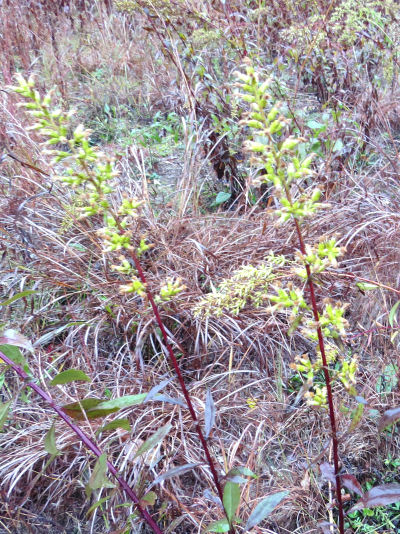
This blue-stemmed goldenrod, Solidago caesia, grows along the trail. Most of the time, the stems are darker purpleish, thus the name. Gray goldenrod also has flowers along the stem like this, but the leaves are different.
blue stemmed goldenrod


This is fun. It's the fruit of a mapleleaf viburnum, Viburnum acerifolium. Supposedly you can eat these, but they are better (like many fall berries) after the first frost. I guess I need to find some then and try them. But since they are popular with wildlife, I may have a hard time finding any!
mapleleaf viburnum fruit


Here's another nice picture of the Manistee River. You can tell that fall is on the way.
manistee river


The reason I was up that way was to meet with a fellow Michigan Outdoor Writer Association member, Dave Foley and his wife Cyndy. He's doing a feature on me for the Cadillac paper before I speak at the Cadillac Area Land Conservancy in October.
friends


In other news: I managed a little editing in the morning before leaving for this adventure.

Miles hiked in 2024: 436.5. NCT miles in 2024: 130.8

North Country Trail, Manistee Co, MI, from Highbridge to Chicago Rd and back with a side trip to Blacksmith Bayou. 3.6 miles NCT, + 1.2 side trip miles

See Old Trail Section, New Season

Friday, October 29, 2021

Swingin' In the Rain

  Today, Cathy and I hiked 9 miles on the North Country Trail in some moderate drizzle. It really wasn't bad at all. But it was gray enough that what little color is in the trees didn't really show to good effect. We weren't singin', but maybe we were walking fast enough to call it swingin' autumn woods

This was the best find of the day. I'm not sure I've ever seen such a pretty toad. It's legs are camouflage, and its body is brown. Believe me, it was really hard to see in the leaves. toad

Where we hiked, there is a small area of prairie, and here are the seedheads of Showy Goldenrod.
showy goldenrod seedheads


The moss was bright green, and a few leaves also had bright colors red leaf on green moss

And, just because I rarely do this, I'll show you the spore print from yesterdays Butter-foot Bolete. I always hate to collect mushrooms in the wild because I want other people to enjoy them. But this was in my yard. Yellow-brown to olive brown... so that probably confirms the ID. butter foot bolete spore print

My NCT miles for 2021 are at 414. Cathy has 78.5 towards Hike 100.

North Country Trail, Lake County, Bowman Lake TH south 4.5 miles and back.

In other news: I worked on trail food. I worked on another hike project, and finished one book-promotion related project. I get to cross off a big thing! Probably one more tomorrow, too. I still have one thing to do this evening. 30 BIG ITEMS to do (32 done) and 24 small ones to do (14 done). 32 days to go.

See Putin' In Some Miles

Tuesday, September 28, 2021

Zig-Zag Goldenrod

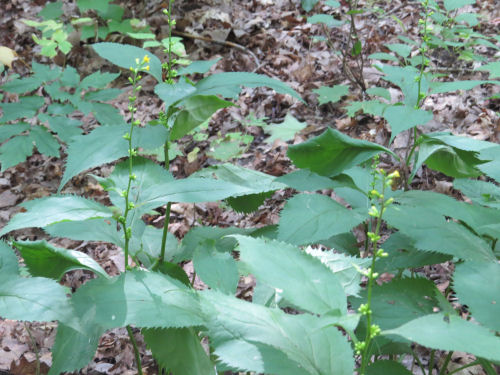
  Here's another species of goldenrod I hadn't seen before the recent trip to NY, although it does supposedly grow around here. This is Zig-Zag Goldenrod. I kid you not. Zig-Zag Goldenrod

The leaves are quite different from most golderods- wide and strongly toothed. The flowers are in sparse clusters. Not fully open in these pictures, but you can tell there aren't going to be tons of them. This specimen isn't strongly zig-zaged, except in a couple of places. Zig-Zag Goldenrod

The name? Solidage flexicaula, easy to remember- Solidago is all the goldenrods, and flexi (flexible) + caulis (plant stem). When I worked at Matthaei Gardens, I had a dream to create a goldenrod garden with multiple native species. I got about 5 in before I was done there, but I don't think any except the very ordinary ones survived.

In other news: I edited, I worked on the trailer, I did errands, and I went to bell choir practice. Nothing new in that list. But I did work hard. Big list is up to 60 things to do by 12/1, and I have crossed off 12. TO DO- 48 things: 63 days.

See Silverrod

Monday, October 5, 2020

Gray Goldenrod

  I did accomplish some things today, but no pictures of interest. We will go back to the Baker Sanctuary for one more new plant. This is Gray Goldenrod, Solidago nemoralis. Notice that it blooms in feathery plumes. gray goldenrod

The flowers grow along one side of the droopy stems. gray goldenrod

The stems are gray, and have fine hairs, which I didn't really get a picture of. And the other thing I didn't get a good picture of is that there are tiny leaves in the axils of the upper leaves. I can see them if I blow up the picture so that it's way out of focus. I'll have to get better pictures the next time I encounter this species. gray goldenrod

In other news: I have the e-book for The Lonely Donkey nearly formatted. And I did a few other odds and ends. Tomorrow is going to be really busy.

See Baker Sanctuary