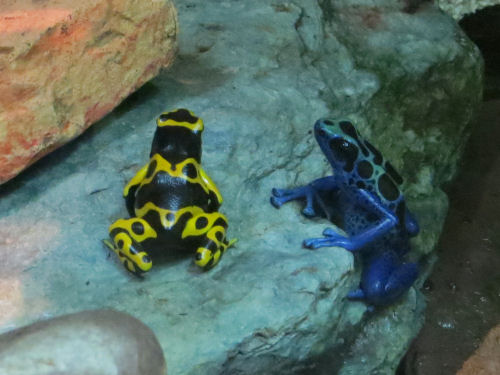
If I were ever going to go to the expense and trouble of an aquarium, it would be a salt-water aquarium. I don't know the kinds of fish, but they are swimming among corals and anemones.
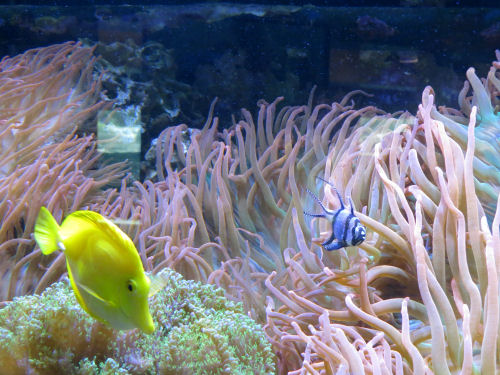
Here's another frog from Central America. This is the Panamanian Golden Frog. It's critically endangered. I know he's hiding, but at least I got a glimpse of it.
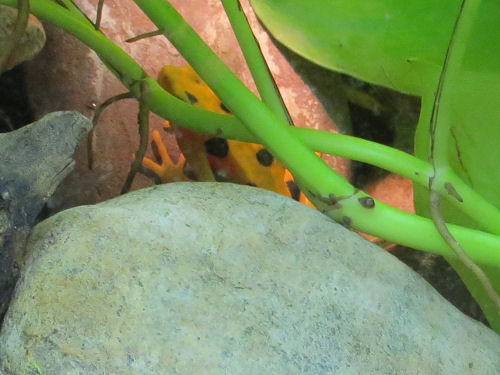
This one is totally weird. This is Henkel's Leaf-Tailed Gecko from Madagascar. There were two of them just plastered flat to the glass like this. From the top side, they looked like dead leaves. You know what's really weird? The front feet seem to have the suction pads in the right place, but look at the back feet. It an animal spreads its back legs out straight, the tops of the feet would be touching the glass. But these geckos seem to be doing just that and there are suction pads holding them in place.

Finally for today, I'll show you an animal which is native to the northeast U.S. But I've never seen one in the wild. This is a Hellbender. It's a giant salamander- the gray blob beneath the log. They are really unique in that they breathe through their skin. To be honest, I thought these were the same as a mudpuppy, but they are not. I'm glad it wasn't completely hiding. This one was only about a foot long, but they can get almost three times as big.

Today was our last day. We finished the book we've been reading together, we played our game, we ate whatever we wanted. It was a nice relaxing day. This blog is supposed to be only the good stuff, so I'll try not to tell you that I'm sad. Tomorrow we each head home although it will take me a couple of days to get there. It's been wonderful!

 | See African Animals |


 This is an approximately 2 mile stretch of the Bristol Branch which also has a return loop so it can be hiked as a round trip. My friend Irene (where I am now staying), and a high school teacher and class, and the naturalist from Letchworth State Park worked together a number of years ago to develop an interpretive booklet and numbered stations. What they produced is quite extensive, and a real resource for teaching. Or, it can be enjoyed more casually by anyone.
 However, plants have a nasty little habit of changing over time. It's perfectly natural. The light changes, or the water table, and plants decide then don't like where they have been growing and die or go dormant. Plants die and others take their place. They grow and shade out other species. It's only nasty if the humans have done a significant amount of work to try to tell other people where they are by means of a booklet.
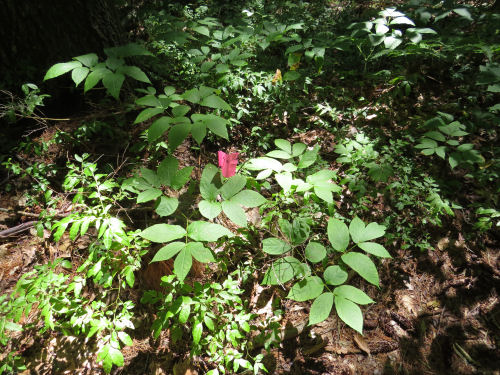 I won't bore you with a five-hour botany lesson (how long I spent on about one mile of trail). But I do have some cool pictures. This is a fungal pattern on Yellow Birch bark
 This golden fungus adorned the base of a tree. Not sure what it is.
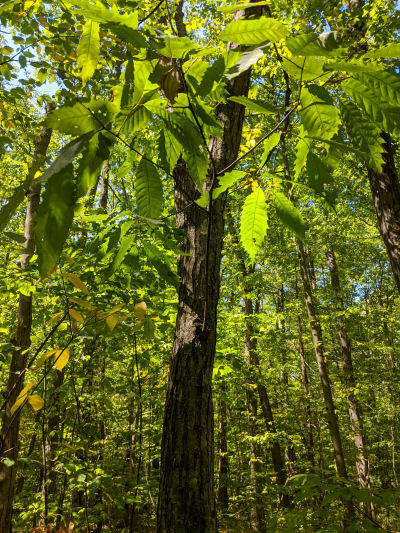
 This is an American Chestnut. There were hundreds of sprouts in this woods, trying hard to make a comeback. Maybe one of them will succeed, and be the forerunner of the genetic winner that will allow the species to overcome the Chestnut Blight. They usually only get a little larger than this one before they die.
 I got half of the sites checked today. I'll need to spend one more day to complete the semi-inventory. (Not a scientifically conducted inventory, but a better-than-casual attempt.) And it will also take about 2 days to get the data collected so Irene can use it to have the booklets remade.