Entries to Win Afghan

Sign up to receive the Books Leaving Footprints Newsletter. Comes out occasionally. No spam. No list swapping. Just email me! jhyshark@gmail.com Previous gifts include a short story, a poem, and coupons. Add your name, and don't miss out!
Showing posts with label vetch. Show all posts

Wednesday, May 31, 2017

Narrow-Leaved Vetch

 
This is a tiny plant growing in my backyard. I've showed it to you before, but these pictures are much better. Sadly, it's alien (as are almost all the vetches), but it's one of my favorites. Maybe because it's small and hides. Maybe because it tries hard to be bold and bright even though it's tiny. I'm not sure why I like it.

It's narrow-leaved vetch, Vicia angustifolia. By the way, just as "cernuum" means nodding, "angustifolia" means narrow-leaved. So if you see that in a plant name... well, it has narrow leaves. Here's how it hides down in the grass.

photo label

There are a couple of really distinctive things about this vetch. For one thing, it only has one or two blossoms on each stem. Most vetches have a whole lot of blossoms on a raceme (stalk). And those blossoms grow right out of the leaf axils (where the leaves meet the stem).

This picture also gives you a pretty good look at the stipule, that little do-dad where the leaf meets the stem. Also look at the blunt tips on the leaves with a point sticking out.

photo label

If you look at the flowers head on, they look very flat. You'd never guess they are long and tublular unless you saw the above view first. This flower is only about a half inch across.

photo label

This is a widely distributed species of waste places and fields, but because it's small it's seldom noticed. For the botany purists, some still consider it a variant of V. sativa.

See Leguminosae
if you like this blog, click the +1   or

Like This!


Sunday, April 13, 2014

Carolina Wood Vetch

 
Just one more flower today. This was a new one to me, although it supposedly grows in all of the eastern US, except New England.

I think of vetches as growing in fields and weedy places. This one likes woodlands. In fact, our guide called it Woodland Vetch. It also blooms earlier than others. However, it has a habit of trailing all over everything and will attach itself to anything else, like all its cousins.

Carolina wood vetch

This one has white blossoms. It was a delicate plant, but showed up well against the brown leaves.

Carolina wood vetch

I'll have to watch for it other places, now. The books call it Carolina Wood Vetch, Vicia caroliniana.

See Cow Vetch
if you like this blog, click the +1   or

Like This!

Friday, June 10, 2011

Cow Vetch


photo label

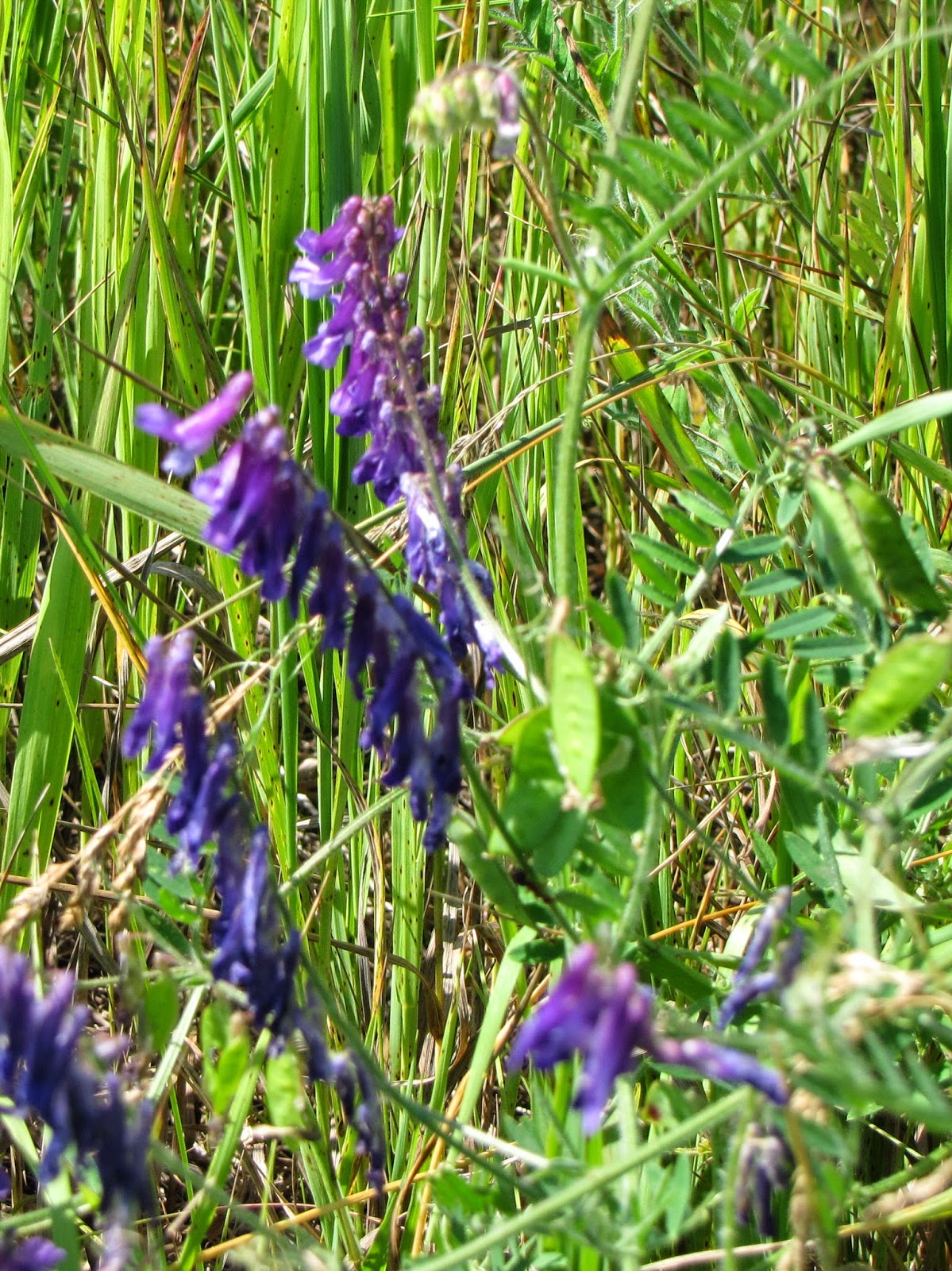
There are SO many vetches, and they are SO hard to understand. I think this one is cow vetch, Vicia cracca. Note how the blossoms grow on only one side of the stem. I was surprised at how attractive the patch of it looked.
photo label

It was growing quite vertically. Although it's not as "messy" as the hairy vetch, it has tendrils that will grab any nearby grass, tree, etc and create a tangled mass of vegetation. But this patch looks quite neat. Here are the leaves.
photo label

Ellen and I got together today and did a variety of things. The weather has gone from 95 degrees on Monday to 57 and raining today. We need the rain, and I like it cool, but what a change!

I have lots of flower pictures, projects, birds, etc. And who knows what I'll select for tomorrow- I only promise that it will be something good!


See Canadian Milk Vetch?
See Leguminosae... OK, Pea Family


Friday, September 24, 2010

Canadian Milk Vetch?


canadian milk vetch

I'm not sure I have this identified quite correctly. The vetches are really tricky, and there are quite a few of them. But of the four that I've found in my field, the white one is least often found. Even though it's white, I'm pretty sure it's not Canadian Milk Vetch, Astragalus canadensis.

hairy vetch

I used to think that it was just a color variation of this Hairy Vetch, Vicia villosa, or the Cow Vetch, Vicia cracca, which is really similar, but all purple. But I'm not sure if it's really a different plant.
white vetch

Here are some buds. I like how they curl
white vetch

The leaves are rounder than the others, too. All three of these that I've just mentioned are good cover crops (they are legumes, so they put nitrogen back into the soil), and they are good food for cows. But they are not good at all for humans, and other mammals with one stomach compartment, to eat. They contain cyanide. A couple of seeds won't kill you, but a large quantity could. In other words.... these are not a wild edible that you should gather!


See Leguminoseae, OK... Pea Family


Monday, July 6, 2009

Leguminosae... (ok Pea Family)


hillside with sweet pea, vetch and yarrow
At this time of year there are a lot of plants in the pea family blooming. I thought I'd show you three of them today. On the hillside above is the dark pink sweet or everlasting pea that I had a picture of yesterday. The dark purple flower you can also see is also a legume, and then I want to show you a less common one. (The white flowers are yarrow, maybe for another day)

sweet peas
For starters, I wanted to show you a more typical example of the sweet pea, Lathyrus latifolius, also called everlasting pea. If you compare it with yesterday's picture you will see the difference in the color. The ones on the hillside above are all that solid, deep pink that seems so unusual to me. Notice the leaves and stems of the sweet pea. To the right of the blossom cluster is a vertical stem. You can see how it is winged, with projections at the joint called stipules. It has tendrils that cling to every blade of grass or other twig, etc, that is nearby. This is a characteristic of many of the Leguminosae. Because of this, the growth habit tends to be "messy."

If you are thinking that you thought beans were legumes, you are right. These are all related, and so now you can guess that the seed pods are going to look similar to bean and pea pods, and you would be right.

hairy vetch blossoms
Here is the dark purple and white flower. The color is lovely, but the plant is a real nuisance. It grasps every stalk nearby it, and makes a maze of plant life that is very difficult to walk through without tripping. It is called Hairy Vetch, Vicia villosa. This is another alien. Amazing how many really common plants don't really belong here, isn't it? Notice the bi-colored blossoms

hairy vetch blossoms
This one is still cow vetch, but here is a bud, and also some of the seed pods. You may be able to see that the there are many more sets of leaves than the sweet pea, and that they are narrower.

cow vetch blossoms

Finally, here is the nifty one, only because most people never notice it. It's Narrow-leaved Vetch, Vicia angustifolia, sadly also alien. This one is much smaller and will hide down in the grass rather than show off like the first two. The flower is not quite 1/2 inch wide. Notice how the flowers grow right out of the stem joints (axils). The leaves are narrow, the whole plant is much more delicate than either of the other ones.

narrow leaved vetch blossoms
And I included this picture so you can see the seed pod. It is sticking up tall on the left side of the shot. Now I know this was a lot of pictures, and information. But just think, there are over 12 wild pea family plants that look very similar, and others that don't look so much alike!

Don't worry, I don't have pictures of all of them!

See I Never Would Have Seen These If... for the dark pink pea
if you like this blog, click the +1   or

Like This!