Entries to Win Afghan

Sign up to receive the Books Leaving Footprints Newsletter. Comes out occasionally. No spam. No list swapping. Just email me! jhyshark@gmail.com Previous gifts include a short story, a poem, and coupons. Add your name, and don't miss out!

Thursday, April 5, 2012

E is for Equisetum

 
I've been working on identifying the genus Equisetum (horsetails) for the past couple of years. I've found 5 different ones around here, and have pictures of 4 of them. (I just can't find the pix of the fifth. I'll either find them, or take more, or both.)

The Equisetaceae are one of the true living fossils. They covered the earth during the Paleozoic Era, and they were as tall as trees. Imagine walking in a forest of these! There was even more variety then. Now, there is only one genus left in the family.

The cone-like structures at the ends of the fertile stems are called strobili. They produce spores. Some horsetail stems photosynthsize and some don't. I'm not knowledgeable yet to know all the details, but I think I can ID all of these species without a book.

The first one is Field Horsetail, probably the most common one there is. These are the fertile stalks, but later in the year sterile stalks grow up with long skinny branches. You might see it beside railroads.

field horsetail fertile stalks

Next we have Scouring Rush. These pictures are of old stems, because it's evergreen. It's also very common. It never gets branches, but just grows those stiff stalks.

scouring rush

Here's one that's lovely, the Meadow Horsetail. I've seen this one grow two feet high! It looks very layered, because the branches grow straight out from the stalks.

meadow horsetail

Finally, one of my favorites. I've found one place where this grows. These tiny clumps of stiff curly stalks are Dwarf Scouring Rush. It never gets branches either.

dwarf scouring rush

The other one I've found locally is Woodland Horsetail. Wish I could find the pic. But I know where it grows! Oddly enough, as early as things are this spring, the horsetails don't seem to be coming up early.

If you want to see all the pictures, follow the link below.

See Equisetum Index
if you like this blog, click the +1  

Wednesday, April 4, 2012

D is for Dogs of My Life - Charlotte

 
Although this puts two family posts in a row (not bad, but I don't usually do it), it's been quite a while since I brought you the next canine in this series. The letter is right, and the timing is good.

Next up we have Charlotte, or to be more precise, "Hush Hush Sweet Charlotte Pork Chop M&M." She has the longest name of any of our dogs. That's for sure!

She came to us in 1972. That's a story in itself. Dear little Bonnie had only been gone for about a week. A friend of ours showed up at dinnertime one evening with a little furry bundle. Being a teenager, it didn't seem silly to him to set her down right in the middle of the table.

I was really torn. I definitely wasn't ready for another dog. But how could I resist this:

german shepherd puppy


She stayed, of course. She was as good and faithful as the breed is known for. She was never too exuberant or too shy or too anything. She was just a really good dog. In those years with small boys I had much less time to bond with dogs, of course.

german shepherd


And, she is the only dog that got included in a professional family picture. Well, we only had one of those ever done. Nevertheless. Here she is, being good.

german shepherd


One summer, we were away and some friends were watching the dogs. The dogs got out, and Charlotte was killed in the road. Our oldest boy (on the left, the one we no longer hear from) found her and buried her under the boys' tree house.

See Dogs of My Life this link will open the series in a new tab
if you like this blog, click the +1  

Tuesday, April 3, 2012

C is for Camping (joke of the week)

 
Regular readers know that I'm a bit nuts about camping, so how can it be the biggest joke of the week?

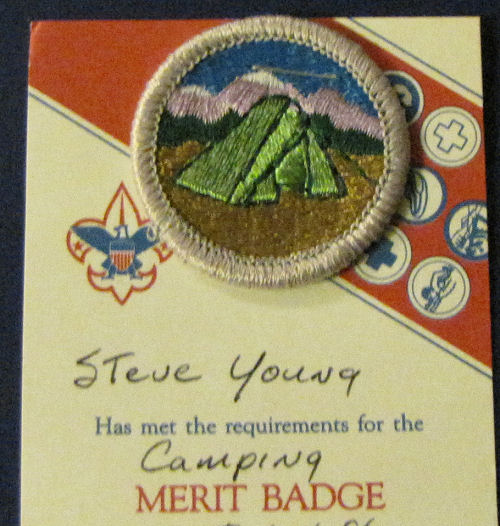
Yesterday somebody knocked on the door. It was the wife of Steve's former Scoutmaster. Keep in mind that Steve is now 37. She rolled her eyes and said, "I really have to apologize. I was cleaning ____'s desk, and found some undelivered badges. So here's Steve's Camping Badge, about 25 years late." We had a great laugh about it.

Boy Scout camping badge

The real joke is how little anyone here likes to camp, except me.

Here's a lesson for you youngsters. Om and I discussed camping before marriage. He said he liked it. I knew I liked it. Oops... be sure to talk about definitions. He calls it camping when you drive around in one of those metal houses on wheels. So not...

Anyway, we did go family camping three times. They were not outstanding successes. However, with the practiced eye of a mother determined to come home with happy pictures for the photo album, I bring you Camping in 1979. (Steve is the little guy with marshmallow on his face, Josh is still burning his.)

cooking marshmallows


eating marshmallows

The bottom line is, Josh did not like being dirty. Omer does not like being cold or outdoors that much. Steve tolerated it all much better, but given choices he didn't want to camp either, once the Scouting years were over.

Me... well, most of you know me... the farther out, the better. (on the Border Route, 2009) I will skip the marshmallow on my face, though.

hiking on the Border Route

if you like this blog, click the +1  

Monday, April 2, 2012

B is for Bunting, Indigo

 
Well, I did it... I figured it would be good to try to draw in some new readers, so I joined the A-Z Challenge. There will be no big changes, except I'll find ways to tack my finds to the appropriate letter of the alphabet. If I begin to get a huge number of comments that are just the "passing through" kind, I may not respond to them all.

Now, for the B. There are still several nifty things from the Saturday hike to show you. One of the very best was spotting a male Indigo Bunting, Passerina Cyanea.

male indigo bunting

They are shockingly blue! But only when it's time to show off to the drab, brown ladies. The rest of the year, they are just brown, too.

The biggest surprise to me, as I put this picture on Shark Shots, was to learn that they are cousins of the cardinal. They are a family of birds, Cardinalidae with large beaks for seed-eating. Some grosbeaks and some buntings, as well as cardinals fit here.

Ellen says that they come to her feeder, but I don't see the indigo buntings very often. I absolutely love them. The slightly more subtle Eastern Bluebird is still my favorite blue bird, for reasons I can't really identify, but the indigo bunting just ZINGS.

See My Bluebird of Happiness
if you like this blog, click the +1  

Sunday, April 1, 2012

May, er... March Apples

 
I'm not big on joining blog games or memes and things, but I could have joined the new A-Z one for April with Apples, since it's what I had planned for today anyway.

The thing is... these are Mayapples, one of the latest wildflowers to appear in the woods. And yet... there they were, with their leaves almost open yesterday, the last day of March. This is one goofy year.

This plant has many common names, Mayapple, hog apple, umbrella plant, duck foot, Indian apple, mandrake root, American mandrake, raccoon berry and wild lemon.

mayapple leaves

It's scientific name is Podophyllum peltatum. There's a message right in the genus name. Podo=foot and phyllum=leaf. If you look at this clump of fully open plants you can see that each leaflet looks sort of like a duck footprint.

All the rest of the pictures were taken in late May 2010, which is much more normal. I thought it would give more continuity to show the stages in one post. Each clump of plants is a single root clone.

mayapple leaves

Once the leaves open, like an umbrella, one or sometimes two large waxy, white blossoms open under the leaves. They always hang downward. Kind of shy, I guess.

mayapple flower

Finally, there is a fruit which is edible if you are careful and lucky. This picture only shows an immature one, not even close to ready to eat. And you don't want to eat them green because they can be poisonous. The fruits grow until they are the size of a very small chicken egg. When they begin to look more yellow than green, you can eat them, and they have a lemony taste. Very yummy.

mayapple fruit

The trick is that wildlife also find them tasty. Even if you find a big patch of Mayapples, it's likely the apples will all have been eaten before they are ripe. Apparently they are only toxic to humans. They usually don't ripen till June or later. Even if you find ripe ones, I've been told you shouldn't eat a lot of them.

Sorry, I don't seem to have a picture of a ripe Mayapple. I thought I did, but can't find it.

if you like this blog, click the +1