Entries to Win Afghan

Sign up to receive the Books Leaving Footprints Newsletter. Comes out occasionally. No spam. No list swapping. Just email me! jhyshark@gmail.com Previous gifts include a short story, a poem, and coupons. Add your name, and don't miss out!
Showing posts with label fasciation. Show all posts

Tuesday, May 28, 2019

Fascinating Fasciation- Starting with an Oops

 
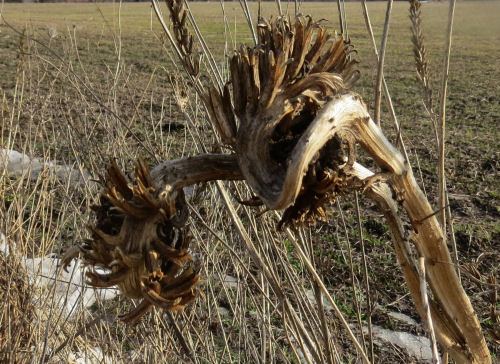
TOTAL CORRECTION: This is actually arctic butterbur, a relative of coltsfoot. I've never ever seen it before! So, discount the first comments.

This picture was taken by Brady Schickinger in a hiking group on Facebook. I'm pretty sure it's not going to key out in any normal way. Perhaps you remember when I showed you the fasciated Evening Primrose (link below). That was also growing in the wild. It looked almost nothing like the plant usually does.

This effect happens for a number of different reasons. It might be genetic, or a fungus, or an insect, or a hormone, or a bacteria, or temperature anomolies, or.... At any rate, something interferes with the normal growth at the apical meristem- the tip where growth takes place. The result usually looks like some sort of monster plant.

arctic butterbur

Although, sometimes, this effect is desirable. Cockscomb Celosia, a popular garden plant, is an example of this. Another example that I've featured from flower shows is the various crested succulents. Here's one, Opuntia subulata cristata

fasciated plant
And another, this one is a Euphorbia, Euphorbia kibwezensis 'crest.'

fasciated plant
Back to the original picture. I'm really not sure what plant it is. There seem to be small four or five petaled flowers at the center of those globs, and it has alternate leaves. This makes me think it's a cress. But without an actual plant to take apart and study, I'm really just guessing.

Today was a total non-starter. I wrote 145 words, and called it a day. I have done nothing productive at all. And I don't really even care.

See Fasciated Evening Primrose
if you like this blog, click

Like This!

Wednesday, February 3, 2016

Fasciated Evening Primrose

 
I know we are overdue for the January goal report, but there are much more fun things to discuss. I'll do that on a slow day.

The other day, as Sylvia and I were walking we saw a whole line of odd-looking plants.

facsiated evening primrose

They were along the edge of a farm field. I went over to take a closer look

facsiated evening primrose

Pretty bizarre, eh?

facsiated evening primrose

Stay tuned. The seed pods are easy to identify as the common evening primrose, Oenothera biennis.

facsiated evening primrose

But something pretty weird is going on with the stems and tips.

facsiated evening primrose

This is known as fasciation, and it occurs when there are mutations in the growth tips of a plant. Some plants are more susceptible than others. I was not aware that evening primrose is one that is commonly affected.

The condition can be caused by a permanent genetic change- this is how the cockscomb celosia came to be. It reproduces with the condition in each generation. Usually, the current generation is the only one affected. Insect or mite damage, radiation, or chemical exposure can cause the condition.

I'm thinking that because of the location at the edge of a field this might have been as a result of pesticide use.

You can see pictures of the same plant, still with leaves, fasciated by radiation exposure at Fukushima Diary

See some other plants with the condition at Wayne's World

facsiated evening primrose


see Evening Primrose in bloom
if you like this blog, click the +1   or

Like This!