Entries to Win Afghan

Sign up to receive the Books Leaving Footprints Newsletter. Comes out occasionally. No spam. No list swapping. Just email me! jhyshark@gmail.com Previous gifts include a short story, a poem, and coupons. Add your name, and don't miss out!
Showing posts with label puppets. Show all posts

Sunday, November 2, 2025

Into the Woods and Into the Woods


You know I love theater, even though I don't seem to attend as many plays as I'd really like to. However, I managed to get to the last performance of Into the Woods at West Shore Community College. Glad I didn't wait too long to get a ticket. They sold out the entire final weekend.

You also may not believe that I've never seen Into the Woods before. My loss. I would like to see multiple productions of it. Meanwhile, this one was great! I've said for years that the best play they ever did at the college was The Wizard of Oz because they had such a standard to live up to since everyone has seen the movie multiple times. However, this one was right up there.

I had a crummy seat and didn't get many good pictures (I always restrain myself if there is a caution that pix are not allowed, but there was no such warning). This is the scene when Cinderella and her step-sisters are off to the ball, Red Riding Hood is on her way to Granny's, and Jack is off to sell the cow.
Into the Woods


Speaking of the cow... although I like to act, most of my experience in the theater phase of my life was with the staging aspects. The cow was a puppet, and it was unbelievably good! Its handler was dressed in black and appeared on stage with it all the time, but it wasn't disruptive at all. The cow as so expressive! In the next picture, Jack is talking with Milky White (the cow's name). You can see the puppeteer in the cap.
scene from Into the Woods


The stage at WSCC is not large. They really need a new auditorium (in my opinion). However, the staging and choreography of a fairly large cast was phenomenal.

In this scene from Act II, you can see that the large trees rotate to become the Baker's house, Cinderella's throne room, and Jack's cottage.

There were three other trees on rollers (see one to the left of the center "house") that the stage hands moved around to create different locations "in the woods."

The trees are gray, and the colors are changed with the lighting. Both of the pictures I got show it in green, but they changed the mood of the "woods" with many colors and pattern effects.

There were also two scenes with a scrim. I was at a bad angle to get a picture of either. Basically, this is a gauze panel that when light shines on it from the audience side it looks opaque, but when light shines from the stage side, you can see through to the "inside."

The lyrics are snappy, the message is actually good. The performance was professional level.
scene from Into the Woods


After the show (which is nearly 3 hours long), even with the return to Standard Time, I was able to hike the short trail aroung the pond at WSCC, so I went Into the Woods! Most of the color is faded, but the low light on this treeline was great.
line of orange trees lit by the sun


Did all the usual things, just not as much time on each.

Miles hiked in 2025: 423.7

West Shore Community College trail, 0.7 miles

See WSCC Hike

Tuesday, July 28, 2015

Rikki-Tikki-Tavi

 
I went to a delightful children's puppet show this afternoon, the story of Rikki-Tikki-Tavi. I wanted to see it because there was supposed to be a variety of puppet types, and the technical aspects of puppets interest me.

Here's a long shot of the set, the puppet theater, so you can understand the staging.

Rikki-Tikki-Tavi

Here, Rikki-Tikki-Tavi (the mongoose) makes friends with the boy, Teddy. Rikki-Tikki is a hand puppet, and the operator could change from the narrator to the boy simply by wearing the mask or not.

Rikki-Tikki-Tavi

Here is Darzee the Tailor Bird. The cobras eat one of the bird's babies. Darzee was a puppet on a stick whose mouth could open or close.

Rikki-Tikki-Tavi

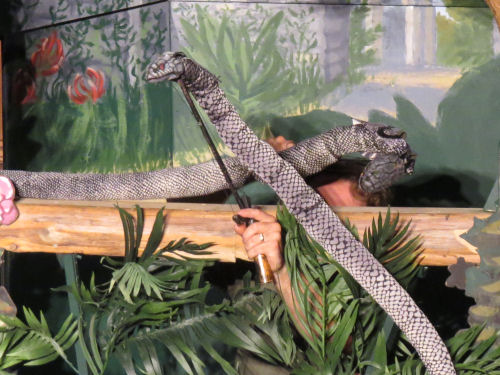
The two cobras, Nag and Nagaina discuss what they will do since Rikki-Tikki has now destroyed their eggs. (The story was re-written to some extent, and the timeline changed, so that only one human character was needed, plus the narrator.) The snakes were stick manipulated with an articulated jaw and a hood that could spread. The bodies were probably rubber, as they could coil around easily and look quite realistic, although I thought their faces were too cartoon-ish and not evil enough.

Rikki-Tikki-Tavi

Rikki-Tikki-Tavi and Nag face off for a fight to the death.

Rikki-Tikki-Tavi

I thought the puppeteer was quite skilled, and the play believable, even though you could often see his hands. The kids in attendance had no problem with this. I watched them a fair amount too, to see how they were following the story.

Here's my take on that. Although they paid attention well, and called for Nag in unison when Nagaina requested it, I don't think the 120-year old story (Rudyard Kipling, 1894) translated well to the world-view being taught today.

The kids often giggled when the snakes were talking to each other, and some seemed to be sorry for Nag when Rikki-Tikki killed him.

And here is the clincher. Afterwards, I overheard two college-age boys discussing the play. One asked, "Why was it OK for the mongoose to kill the cobra's eggs, but not OK for the snake to kill the bird eggs?"

In this day and age of having respect for life forms of all kinds (although I'm betting these kids will gladly kill a mosquito), the reality of cobras being an ever-present deadly threat to a family living in India has been lost. The reason the story was meaningful to children and adults in the past was because there were real dangers near at hand, and of course people were going to value animals who protected them above those who sought to harm.

I missed the very beginning (wrote the time down wrong), but I think, sadly, this story would probably need introduction to help today's children relate. Perhaps that was done. I just don't know.

Literature from other ages is always valuable, but sometimes we need to educate ourselves or an audience to understand it.


Read Rikki-Tikki-Tavi
if you like this blog, click the +1   or

Like This!