Entries to Win Afghan

Sign up to receive the Books Leaving Footprints Newsletter. Comes out occasionally. No spam. No list swapping. Just email me! jhyshark@gmail.com Previous gifts include a short story, a poem, and coupons. Add your name, and don't miss out!
Showing posts with label Wetlands Research Inc. Show all posts

Saturday, March 30, 2024

Summer of 1993 - Alien Plants

 The next couple of days are going to be about plants. They are not going to be a good representation of the plants that were on the site at Wetlands, Research, Inc. What they are is just whatever pictures I have that aren't too awful, or that I can "fix" to some extent.

First up is a species I was not familiar with at all before that summer. It was a beautiful thistle, but highly invasive, native to Europe, Central Asia and North Africa. Every stage of the plant is attractive, but it was pretty much taking over any disturbed soil. It is Nodding Thistle, Carduus nutans. I don't have a picture of the rosette, but it was large and spiked all over, looking quite nifty. Here is the bud developing.
nodding thistle


It grew tall, and the flower head was large, a couple inches across. As it matured, the flower would turn to face downward, thus "nodding."
nodding thistle


This picture doesn't have the flower in focus, but it does show how prickly the whole plant is. It's about as uncomfortable to touch as our Bull Thistle.
nodding thistle


Next up is a plant that was growing on/in most of the ponds. This is White Water Crowfoot, a buttercup, Ranunculus aquatilis. It's native to the western US, but can really clog up ponds. And it prefers slow-moving water, so we made it very happy. When it blooms, the flowers are only about an inch across and stick up out of the water, but the roots and leaves make huge floating mats of vegetation.

Let me say, that I wasn't quite at the beginner stage of plant mania, but it had only been a couple of years earlier that I was challenged to be more professional and learn scientific names. (Maybe I'll tell you about that trip some day.) And, I certainly hadn't been introduced to the idea of major efforts to remove invasives. But I was beginning to be aware of their problems.
water crowfoot


Here's a real baddie. You probably know this one, especially if you do trail work. This is one of the primary invasive species on everyone's hit list. It's Multi-flora Rose, Rosa multiflora. It's native to the Far East and was brought here as a garden plant. It forms large dense shrubs that crowd out everything else. Not to mention the thorns.


You might be surprised to learn that teasel is also alien and invasive. You can't tell from this picture, but I remember that it's Cutleaf Teasel, Dipsacus laciniatus. I've featured this plant on the blog a few times because it also grows around here. Anyway, the flower heads are pretty and the seed pods are nice in dried arrangements. Those spiky seed heads have also been used historically to do things such as card wool. But it can form monocultures and crowd out other plants.
teasel head


While we are on the topic, let me just say that cattail, Typhus sp., is native, but it can also form monocultures and crowd out pretty much everything except muskrats and red-wing blackbirds. There is considerable discussion about how much of it should be allowed to grow and fill in ponds and wetlands. There isn't one right answer. If your wetland is for water treatment, it really doesn't matter. But if you want to create a diverse environment for visual enjoyment and wildlife habitat, you may need to do something to keep the cattails in check.

When I went back to U of M that fall and began working on the constructed wetland project at Matthaei, one of my duties was to try to promote native plants and remove invasives. I got real familiar with the myriad invasives and up-close-and-personal muddy all the time digging and pulling. It was a never-ending job. However, none of that was on my job description here.

In other news: I wrote my Get Off the Couch column and edited.

See Inside Duties

Wednesday, March 27, 2024

Summer of 1993 - Inside Duties

 Here's where a spent a huge amount of time on the days I was not collecting samples or cleaning culverts. This is the lab trailer.
laboratory trailer


I tried to look up all the tests I did on every single sample bottle. I'm not sure I have them all, but based on some old spreadsheets, I think it was pH, conductivity, BOD (biological oxygen demand), total Phosphorus, Chlorides, and ammonia. I don't remember much about a lot of it... you just follow the "recipe" in the Standard Operating Procedures manual. Phosphorus and Chlorides required chemical reactions. The picture I recently posted on Facebook, and put last in this post, of me doing chemical analysis was a Phosphorus test... there was one step in there where you had to let the sample turn pink with the addition of drops of reagent. That picture, of course, was in a much nicer lab.

This is one of the stations that I only had to do an instrument reading. And I tried to count the bottles. It does look like 27 or 28. Of course, there was a big backlog of samples to be tested when I got there. Someone else had done collecting and filled the refrigerator with bottles, but they were waiting for the grunt grad assistant to show up to do the tests.
laboratory bench


And putting that instrument to use.
doing lab tests


Looks about the same, but maybe this one is conductivity. I have a vague memory of what that instrument looked like
researcher in lab


Well, doing this over and over got pretty boring, but it was part of the job, and I got a lot of satisfaction out of doing a good job and preparing the graphs showing that the water quality improved as the water flowed through the ponds.

The very worst part of the job was that after testing was complete, all the sample bottles had to be acid washed to remove all traces of the previous water. This means they got washed with soapy water and a brush, rinsed, then a squirt of concentrated sulfuric acid went in each bottle, swished around and rinsed again. Then they were air dried. The acid was in a squirt bottle, but I kept dedicated clothes for all the acid washing, because you were sure to get holes in your clothing.

Where was Chips when I was doing all this? Well, you know, he was a great lab assistant.
dog in a lab chair


That fall, when I went back to U of M, I began as the project coordinator for the constructed wetlands at Matthaei Botanical Gardens in Ann Arbor. I did a post about that. After that was built and functioning, it involved doing all those same tests, collecting monthly samples for five years and doing all that lab work. That's where this picture was taken.
person conduction chemical test


Somewhere here, I want to say that this was all under the instruction of Dr. Robert Kadlec. He was one of the pioneer researchers in demonstrating the capabilities of wetlands to remediate contaminated water. He literally wrote the book on the topic. I was thrilled to be working with him, and that all went well, but my difficulties at U of M came about because I was getting my degree in a different department from his. It's a long, stupid story. Some my fault, some not my fault, but the end result was that "my" department didn't want me. It happens. Grad school can be brutal.

Tomorrow, I get to play outside all day so I'll blog about that. But we'll come back to 1993 for at least one more day after that.

In other news: I finished the big editing job and am making good progress on the trail book.

See Other Outside Duties

Tuesday, March 26, 2024

Summer of 1993 - Other Outside Duties

 One reason that I got to know Ike so well was that I was his backup person. He had to teach me how to do all the regular things he did so I could do readings in his absence, and we spent a lot of time together. I certainly wouldn't have been able to fix any of the electronics, but sometimes I did the basics.

This is Ike taking a reading from one of the rain guages. I think we had two of them at opposite ends of the property. These had a revolving drum and a roll of paper that took readings all the time and recorded it as a graph. I think the paper had to be changed once a month. Don't take me to task if you know a lot about these and I haven't remembered perfectly. It was a long time ago, and I didn't really do much with it. I think maybe I changed the roll one time.
reading a large rain guage


I showed you on an earlier day that Ike took the readings from the weather station. But I knew how to do this too. It really was just a matter of plugging that handheld unit in to the feed from the station on top of the tower and making sure the numbers came through right and not just gobbledegook.
reading a weather station


Doing all these things took time. It's a 500 acre site, and mostly I walked to the locations. They are still in operation. Their website says they have 4 ponds, so either they removed two or my memory is bad. Could be either. This was 31 years ago, and I didn't keep a journal.

Ike's top priority was to check on the main pump that drew water from the river. But he had to teach me what to do if it quit, which occasionally happened. I think something had to be reset every few days. Looks pretty compicated, right?
control panel for a large pump


Well, it was pretty complicated, and I knew nothing except how to punch in the reset codes. However, it did go down late one evening when I was there alone, so they were extra glad someone was on site that day! If that hadn't worked, I would have needed to call Ike.
pushing a control panel button


Ike's other primary duty, and he HATED it because it kept happening over and over, was to deal with this. Where the water went back into the river, in other words, at the far end of the property, was a small double culvert where the water flowed out. Well, you can sort of see where two holes are supposed to be at the bottom of that pile of cattails.


Yes, there were beaver, and it was their great burning desire in life to keep the water in the pond. Every couple of days, Ike had to go back there and clear the culverts. I often helped him.
open culverts


It was amazing how quickly the beavers (whom I NEVER saw) would plug things back up. Sometimes they got really serious and used more mud than vegetation. This isn't the exit culvert. I'm no longer sure where this went, but they did a fine job. Ike was not pleased.
culvert plugged with mud by a beaver


And how about that Chips? He was having a grand time learning about the world. Like how wind makes waves on the water and they require barking. He was still pretty little in this picture. He hadn't yet turned into the dog that could not be kept out of the water. That didn't really happen until he was maybe 6 months old. Before that, he wasn't afraid of it (Maggie hated the water), but at this he stage he would not yet jump into anything wet.
puppy barking at waves


There was no particular amount of time I was required to spend working. I just had to complete all the tasks, which wasn't much of a problem as long as I wasn't a slacker. The inside jobs took a huge amount of time. We'll visit them tomorrow. But I'll say again that this "job" was heaven on earth for an outdoor-loving human and a puppy.

In other news: I'm almost done with the big editing job I've had for a while, and I'm working on formatting my own book, and played with the cover a bit. I've spent all day working with fonts and graphics and my head is spinning. Still no car.

See Regular Outside Duties

Monday, March 25, 2024

Summer of 1993 - Regular Outside Duties

 Most of my duties as a research assistant had to do with monitoring how well the wetland treatment system was working. Three times a week I took samples from a number of different locations, and checked the temperature of each pond. Here, I'm pulling up the thermometer to get the reading of that pond at the outlet weir.
checking a water temperature


I'm not sure I can remember all the places I had to take a sample from each pond, but for sure the inlet water (where it came up the pipe from the previous pond in the series).
sampling inlet water


Also, water had to be collected from each outlet before it ran out the weir.
taking a water sample


And the fun one was getting a sample from the approximate center of each pond. For that, there was a canoe. I was usually going out alone, but SIL Loretta visited me there and someone took some pictures of us, so there were two people in the canoe that day.
canoe on a pond


Then there were these automatic samplers that pulled one sample each day. Battery operated, and the sampling bottle was larger than the usual small ones. Each unit was about the size of a 55 gallon drum. The top snapped off, and they held a circle of bottles. The cover snapped off.
portable pump


And then you lifted off the battery housing. Under there was where the bottles rested in a ring around the edge.
researcher


So that makes 4 samples from each pond, which would be 24. Seems like there were 27 in each batch, but I'm not sure why I think that. Maybe the river at the pump, the river below the final outlet, and somewhere else?

Stay tuned for what happened to these 81 samples that were collected every week.

Meanwhile, if the weather was hot, I also took care of watering the test plots that were the project of the other couple- the ones that had less well-established plants. Chips loved to play in the sprinkler!


And where was Chips when I was collecting the other samples? Right there with me, of course. He got to be quite the canoe dog. I have no idea how he managed to stay put on the slopey prow of an aluminum canoe, but this was his favorite perch. He was beginning to show his desire to always be "top dog."

I also have a funny story about something he learned the hard way. We were coasting in to the shore where I would pull the canoe out, and the surface of the water was completely covered with green duckweed. He thought it was solid and leaped onto it as if it were land. Imagine his surprise when he got a complete dunking and came up totally green!


In other news: It's quite a bore, even if important to do- I edited, I wrote, I walked to the post office.

Total miles hiked in 2024: 169.8 of which 52.8 is North Country Trail

See The Cast of Characters

Sunday, March 24, 2024

Summer of 1993 - The Cast of Characters

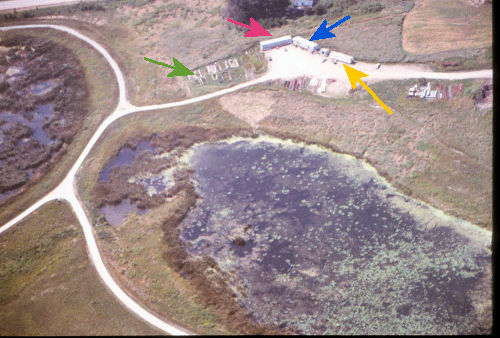
 I did find a good picture that shows the space where we worked. Along the entrance drive were three trailers. The one with a pink arrow was the office. The one with the yellow arrow is where I lived. They actually were very glad to have me stay on site. There wasn't any particular security problem, but they were happy someone was there in case something came up. The blue arrow points to the laboratory trailer. An awful lot happened in there.

The green arrow points to some test plots. And you can see a couple of the ponds nicely in this shot.
trailers on a research site


There were a few people who were there every day. This couple... I think her name was Cathy, but I don't remember his, were doing research as to how well wetland plants grew under various conditions. I really don't know a lot about their research, or I don't remember. I do remember they owned a cat named Typha. If you get it, you get it.
researchers


They always had various plants growing in tubs with tags all over them, and they were constantly monitoring those test plots with the green arrow above.
growth test plots


The other person who was there almost every day was a man named Ike. I think he might have come from Iran, but I don't remember for sure any more. Anyway, he had been an engineer in his home country, but was having trouble passing the exams in the U.S., so he took any jobs he could get that were in his field. He was my best friend of the summer.
researcher


Basically, if something had electrical components, it was Ike's job to maintain them, take various reading, etc. Here, he's downloading measurements from our weather station that was at the top of the tower.
researcher


There was an archeaologist there part of the time. The site where the ponds had been built had all been checked before that was constructed, but there were other properties where he was looking for native artifacts. I don't remember his name, either.
researcher


I got to go with him a couple of days. If I recall correctly, I didn't find any actual arrowheads, but I did find a few pieces of worked chert. He would collect all day, then come back and catalog all the findings.
archaeologist


And then, there was me. Remember, I was a research assistant. I had a long list of duties to perform, and I really enjoyed every minute of what I did there, although a lot of it was quite simple. More on that another day (or two).


And puppy Chips. Don't forget Chips!


In other news: I finished scanning all the slides from Wetlands Research, Inc., I edited, I wrote, I did some housework.

See The Playing Field

Saturday, March 23, 2024

Summer of 1993 - The Playing Field

 I was at the Wetlands Research, Inc. (WRI) site in Wadsworth, Illinois, as a graduate research assistant for the summer of 1993. But before I get into what I was doing, I want to tell you more about the area, and what the organization was trying to accomplish.
wetlands research institute sign


This land is directly adjacent to the Des Plaines River, and there is a very good reason for that.
des plaines river


Another non-profit organization had as their goal to restore oak savannah lands along the river banks. These are native eco-systems that are almost park-like. They are characterized by mature oaks with low understory and grasses. They are transition zones between prairie and eastern woodland, and often need fire to preserve the open spaces. The mature trees are tolerant of the low ground fires.
oak savannah


Through "our" property, and continuing for 56 miles, the Des Plaines River Trail follows the river. Portions of the trail have existed since the 1920s. Where I was, it was a crushed limestone surface, multi-use, but non-motorized. Every day at 6 pm, the gates to the WRI property were locked. Everyone else who worked there went home. Chips and I were locked inside because we lived on site. Are you beginning to get the sense of how I managed to go to heaven without dying?
desplaines river trail sign


What WRI had to do with this whole thing is that it was a series of constructed wetlands designed to help clean the water from the Des Plaines River. This is an aerial photo (yes, I got an airplane ride before the summer was over). The road across the lower part of the picture ends in that little turnaround where the pumping station was located.

You can see the river curving around the left side of the picture. We pulled water from the river and fed it first into those wavy channels. It was beginning to be understood at that time that wetlands were very good at filtering and cleaning water. The channels are beds designed to help that filtering process by keeping the water moving very slowly and allowing natural bioremediation processes to take place.
wetland water treatment beds


From there, the water went to six "treatment" ponds. Here is a view of a couple of them. I may have a better picture. I discovered another whole box of slides from that summer, just when I thought I was almost done scanning, and I think it has some of the better ones. I hope to do those tomorrow. Anyway, you get the idea.
water treatment ponds


Some of the ponds looked very appealing and recreational.
open water in a wetland


Some of them were perhaps less aesthetically appealing to those who like nature to look clean, but they were very good at doing their jobs.
wetland


After the water went through these ponds it was released back to the river. I'll just say that my duties had to do with monitoring how well the cleaning process was being accomplished. I'll tell you more about what I actually did in the coming days.

In other news: I edited, I wrote, I walked to the library, and I made yogurt.

Total miles hiked in 2024: 167.3 of which 52.8 is North Country Trail

See Summer of 1993 Intro