Entries to Win Afghan

Sign up to receive the Books Leaving Footprints Newsletter. Comes out occasionally. No spam. No list swapping. Just email me! jhyshark@gmail.com Previous gifts include a short story, a poem, and coupons. Add your name, and don't miss out!
Showing posts with label wetlands. Show all posts

Saturday, December 27, 2025

Familiar Places


I decided I better get off my butt and take a walk today. Ever since the big NCT hike, I have been unable to get enthused about my road loops. I used to just do them without thinking about it a lot. However, I've now shown you just about every shred of variety, particularly on the 3-mile one, unless some stray wildlife happens along.

Anyway- here are the water features I usually show you. And I did actually learn something new.

This is the pond along the bypass. I've seen several interesting ducks here. But not today.
small pond in winter


What I learned today, by looking at several different maps, is that this "pond" - not much more than a wetland, is one possible source for the Cemetery Creek (my name- it's totally unidentified on any maps).

At the link below, you can see my journey to try to follow that creek to its source, but both in summer and winter (I would link to that, but the pix have disappeared and I'm too lazy to try to find and reload them today) I ended my search at another large wetland area.

Today, I did a 4-mile loop which takes me past another wetland area I share fairly often on Johnson Rd.
wetland


There is a small drainage creek that flows out of it. It's been channelized. But look. I found a map with it showing.
creek map


Since this arm is longer, I guess technically, this is the source of the Cemetery Creek. Here's the drainage channel. You can see that it joins the other branch of the creek south of the highway (and south of the railroad tracks, and the cemetery) and heads for the Pere Marquette River.
small creek


And now, as I am completing my road loop, I pass the Cemetery Pond, which is on what I guess I'll need to call the East Branch of Cemetery Creek. This pond usually isn't very pretty. But here it is, a small body of water on my ho-hum loop, so I do share occasional pictures.
small pond


Edited, paid bills, played my game. Took this walk. Which raises a big question.

Miles hiked in 2025: 479.5. Am I going to shoot for 500? I'd need to do a 5-miler each of the four remaining days. I think I could. I have no pressing engagements. And here's another question. Om bought a cheap treadmill a month ago. I've done 6 miles on that which I haven't counted toward miles for the year. They seem like fake walking, but I suppose they could be counted.

Road loop near home: 4 miles

Stay tuned for the answers.

See A Creeklet Excursion- Revisited

Monday, April 21, 2025

Blackie Finds Pinkie

 They won't get planted out of thier pots until tomorrow (I've been hardening them off and tonight is supposed to be really cold, but then it will warm a bit), but the black sempervivum has found some pink friends. You may remember that a few days ago, I discovered that after year one (or at least in early spring) the 'Black' sempervivum really is nearly black.

The pink flowers are Lewisia. I had one once long ago and it died. I never could understand why, because the rock garden should be a place that makes it really happy. But it was small and came by mail order. These are larger and healthy. They are native to the Rocky Mountains. I think these look great together.
black sempervivum with pink lewisia


Monica and I went out to the North Country Trail today just for a short while to check on some things for an upcoming event. I had not realized that this wetland was visible from the trail when there are no leaves on the trees!
tank creek wetland


You know I love new information! This is a wetland that is the headwaters to Tank Creek. I have wandered around there a few times in the past, but got there from a different starting location. The link below is on a nicer day when dog Maggie and I visited years ago.

We didn't walk enough distance to say boo at. I won't count it for Hike 100, but I'll use it to get my yearly mileage back to an even number of tenths.

I did a number of small things I was supposed to do in addition to the time with Monica today.

Miles hiked in 2025: 138.5

See Still Too Early for Flowers

Monday, March 17, 2025

Philadephia Flower Show- For Peat's Sake

 This was another of the Standard Flower Show contests at the Philadelphia Flower Show 2025. The assignment was to create a "pocket garden that encorporates a bog garden area."

We need to start with defining a bog. A bog is a wetland that is acidic, and it will support particular kinds of plants.

Oddly enough, the blue ribbon entry is titled "The Mysterious Fen." Now, let me explain that a fen is also a wetland, but it is the opposite of acidic; it is basic. Completely different kinds of plants grow in a fen.

I have to confess that I was rushing so much to take pictures of entries that I did not stop to examine the plant material carefully; however, what I can see and ID is not necessarily suited even to a fen. The corkscrew rush is pH normal to acidic. Most of the other plants I may be figuring out are from all over the world, and would never be found together. The intent even says that: "an enchanting convergence of native and foreign growth- a mystical vortex."

The judges said, "Wonderful composition."


Second place went with something more realistic titled "Guardians of Tomorrow." This depicts the cedar bogs of New Jersey, and states "the reddish-brown watery bogs of New Jersey's Pinelands are our protectors." Well... this warms my heart because that is exactly the kind of thing I was studying for many years.

The judges said, "Wonderful use of bog plants."


Everything you can see even in this corner is really is a bog plant. Two kinds of pitcher plant, a flytrap, haircap moss, wild cranberries, and a clubmoss.


Third place is "Through the Pitcher Window." This is a play on words, with a lot of kinds of pitcher plants- reminder: these eat insects. The intent says, "Pete reflects on his carnivorous plants in his peat rain garden."

The judges remarked on the varieties and quality of the various pitcher plants, but thought the window was out of proportion to the exhibit.

Note, there is a pitcher of purple pitcher plants that you can see through the picture window.


There were three more entries which all got honorable mention.

This one is called "Whimsical Wetlands," and the judges thought it could be more "robust." It is pretty realistic, but not much artistry.


This one is called "The Mystical Side of Nature," where "magical plants sway eerily in the evening."

The judges said is was "enchanting," but the azalea was not suitable. Well, there are native azaleas that do grow in bogs, but this is just a commercial one, although they all prefer acid soil. This would certainly have done better if they had used a different azalea because the ferns were carefully chosen and the garden is colorful.


The last bog garden was called "The Living Canvas" which "invites relaxation and reflection."

The judges said it was a lovely collection, but that the houseplants were not suitable." I have to agree. There is nothing about this that says "bog."


OK, at a flower show where I am Queen, the New Jersey Bog would have taken first place for having actual bog plants, the diversity of native plants, adhering to the theme of the entire Flower Show (Gardens of the Future), and having the structural element (the log) at a diagonal instead of straight (the rock stream) in the one that took first place. So there.

I was sort of tired all day. I didn't sleep well. My head and face were itching like crazy and I took an extra pill and got out the ice pack again. This is all very normal for the neuralgia, but there is no way to know how long it will continue.

I puttered at various jobs and took a tiny walk that doesn't even count.

See PFS- Lab to Landscape

Wednesday, May 29, 2024

Shiawassee Wildlife Refuge

 Driving home today, I made a stop at a place that I can write about for my next "Get Off the Couch" column in the paper. Did you know there is a national wildlife refuge over near Saginaw? It's the Shiawassee National Wildlife Refuge.
shiawassee wildlife refuge sign


Some refuges have more hiking trails than others. This one has multiple choices. I did all of the Woodland Trail (almost 4 miles), and sampled the Fergusen Bayou Trail. It's over 4 miles long, but I went in as far as the first observation platform and back out. The two areas are quite different. The Woodland Trail is through a wet woodland. The Bayou Trail is on dikes through a marshy area with wildlife observation decks.

This will just be a sampler. Of course I came home with too many pictures. For you, I have 2 trees, 2 flowers, and 2 wildlife picture.

The Swamp White Oak, Quercus bicolor is supposedly found in Mason County, but it's a lot more common south of here. It's easy to spot. The leaf is much wider at the tip than at the stem end, and the leaves are very white on the back side-- "bicolor."
swamp white oak


Another one I don't see too often is Red Hickory or Pignut, Carya glabra. The odd thing is, this is pretty much an upland tree, but it was in this bottomland hardwood area. But the bark and everything I can see at this time of year makes me fairly sure of the ID. Anyway, another cool find I don't see locally.
pignut hickory


Flowers in abundace were the Canada Anemone, Anemone canadensis. This is a really handsome late spring flower, and it will agree to grow densely enough that it could be used in flower beds.
canada anemone


And yet another wild rose that I have trouble sorting out because I can't seem to remember what to look for. However, I'm pretty sure this is Smooth Rose, Rosa blanda. Ha! The U of M Herbarium says R. blanda does not grow in Michigan. Well... it has very few thorns and the leaves are very blunt at the ends. The wet habitat makes me suspect it's Swamp Rose, Rosa palustris, which would make sense here. But the leaves aren't right, and of course I didn't look for other key characteristics when I was there. I can definitively say, "it's pretty."
smooth rose


There was the requisite spring picture of a family of Canada geese. Actually, I saw several families, but the babies were smaller and cuter in this group.
canada geese with babies


I saw a number of birds, but getting pictures of those was illusive. The birds were pretty active for mid-day. Several great blue herons, a pileated woodpecker, a brown creeper, and all the usual suspects.

Here's another typical spring picture. Mama was there, but stepped out of the picture. The baby stood completely still, as they are "supposed" to do.
whitetail fawn


I think there is a particular kind of beauty in wetlands, sometimes even the places that some people might not find so attractive. Here are two examples.
shiawassee wildlife refuge


Busy day. Chatted with my host, took two walks, drove 3.5 hours, unloaded the car. Tomorrow, another adventure is planned. Stay tuned

Miles hiked so far in 2024: 243.7.

Shiawassee National Wildlife Refuge, Woodland Trail and part of the Ferguson Bayou Trail, total 6.3 miles

See Montezuma Wildlife Refuge

Saturday, April 13, 2024

Heritage Nature Trail - Cadillac

 After the vendor event today, I took a short hike on the Heritage Nature Trail at Mitchell State Park in Cadillac. I had been there once before in 2015 (link below).

This is a large man-made wetland area between Lakes Mitchell and Cadillac. Black Creek, seen here, used to be used to float logs between the two lakes, but it was too shallow, and a canal was eventually dug. This changed the hydrology of the area enough that this became about 70 acres of wetland.
black creek cadillac


Since it's now preserved as a nature study area, that is a good thing. Most of the trail is in the form of a raised berm that goes in a rectangle around the area. At least it's dirt. But despite being close to two busy highways, it's known for great wildlife viewing. There is a spur into the middle of the marsh with an observation platform. I went out there, but it's pretty early to see much. There were a couple of slow peepers.

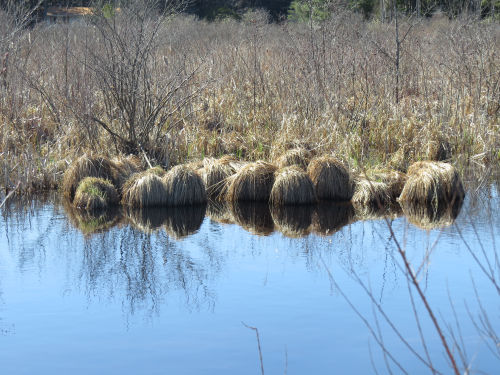
I really liked this collection of hummocks along the diverted section of Black Creek that surrounds the wetland.
hummocks


Saw my first turtles of the year! Just painted turtles, but that's OK. I like to play the game of "which will be first?" Some years it's been a Blandings.
painted turtles


I wanted to take the outer loop, and I did. But the cut-across loop was so attractive, I had to walk it too (both directions, eh?). It goes over what they call "hemlock island." Since nobody was keeping any kind of records when this land was all changed, they don't really know why it's higher, or why (uncharacteristically) hemlocks are growing that near a wetland. But it was a beautiful section of trail. Two humps with hemlocks, and one lower section with a boardwalk through the marsh.
trail in hemlocks


On the walk back, I cut over to Lake Cadillac.
lake cadillace


The willow trees are getting all sexy. This is goat willow, Salix caprea, alien. But the male catkins sure are fancy.
goat willow catkins


With the extra bits of trail I did and the out and back pieces, I managed to turn it into a four mile walk. There is lots of interpretation, and would be a nice walk with kids. Probably you'd see a lot of wildlife activity on a summer evening.

The vendor event went OK. They didn't manage to pull in a very good crowd. I sold a few books and talked with a lot of people. But a few of my friends came. Sorry, no picture of Miki, but I finally got a pretty good one of Eamon!


Total miles hiked in 2024: 193.6 of which 69.6 is North Country Trail.

Mitchell State Park, Cadillac, MI, Heritage Nature Study Trail. with spurs. 4.0 miles

See Sunday Hikes

Sunday, March 31, 2024

Summer of 1993 - More Plants

 Today, I have a selection of more plants from the summer of 1993. Again, this is driven only by what I have pictures of. There are some pictures that I can only guess what the plant was. Forget using those! Remember, this was back when you had to have film and wait days to see if you got anything good. And I only had a moderately good camera at that time. It was better than an Instamatic, but I wasn't as careful as I might have been. Or perhaps I was trying to take pictures with one hand while holding Chips with the other. Who knows!?

Everyone loves water lilies. This is the common water lily, Nymphaea alba. It's native, as are all of the plants I'll show you today. It likes water at depths of 1-3 feet, so it was very happy in our constructed ponds.
water lily


Golden ragwort, now Pakera aurea (it used to be Senecio), is a lovely open woodland and meadow flower. One thing that is a lot of fun about this one is that the buds are purple, so it's a big "surprise" when the flowers turn out to be yellow. That also grows here.
golden ragwort


Many of you will likely recognize this plant. It's common in rich woodland of Michigan. This is great Solomon's Seal, Polygonatum biflorum. You can see how the flowers hang in clusters of two, biflorum, under the leaves.
Solomon's Seal


Don't forget Chips... he liked plants too, just usually when they provided nice shade.
puppy under solomon's seal


This one is Golden Alexanders, Zizia aurea. It has a lot of lookalikes, so you have to pay attention to the leaves. The most common mis-identification is with Wild Parsnip. I have to keep looking them up to remember the difference myself. But the Alexanders have compound leaves with 5-7 oval leaflets. Like the other plants featured today, except for the water lilies, it will tolerate everything from wet meadows to woodlands.


My final plant for the day is one I've only ever seen that one summer. It doesn't grow in Michigan except for a couple of odd finds in the SW part of the state. Again, it will tolerate wet or normal soil, but it does like limestone, and is a transition plant from prairie to forest, like the savannahs that were being reestablished.

And, I didn't take its picture. I drew it. The reason I'm not a very good artist is that I don't have the patience. I only drew the flowers, not the leaves. But I know what it is anyway. There are only a couple of choices, and the truly rare one is far west of where I was. This is Shooting Star, Primula meadia (used to be Dodecatheon). I'd love to find more some day. It can grow to about 20 inches tall. I think this one was maybe 12-14 inches.
drawing of shooting star flower


Tomorrow, I have some more flowers. I learned quite a few that summer that I don't have pictures of, but I have a couple of prairie plants.

In other news: I'm trying really hard to get the North Country Trail book ready to go to my advance fact-checking readers. I worked my brain to a mushy pulp today. I think it will be ready to send tomorrow.

See Alien Plants

Wednesday, March 27, 2024

Summer of 1993 - Inside Duties

 Here's where a spent a huge amount of time on the days I was not collecting samples or cleaning culverts. This is the lab trailer.
laboratory trailer


I tried to look up all the tests I did on every single sample bottle. I'm not sure I have them all, but based on some old spreadsheets, I think it was pH, conductivity, BOD (biological oxygen demand), total Phosphorus, Chlorides, and ammonia. I don't remember much about a lot of it... you just follow the "recipe" in the Standard Operating Procedures manual. Phosphorus and Chlorides required chemical reactions. The picture I recently posted on Facebook, and put last in this post, of me doing chemical analysis was a Phosphorus test... there was one step in there where you had to let the sample turn pink with the addition of drops of reagent. That picture, of course, was in a much nicer lab.

This is one of the stations that I only had to do an instrument reading. And I tried to count the bottles. It does look like 27 or 28. Of course, there was a big backlog of samples to be tested when I got there. Someone else had done collecting and filled the refrigerator with bottles, but they were waiting for the grunt grad assistant to show up to do the tests.
laboratory bench


And putting that instrument to use.
doing lab tests


Looks about the same, but maybe this one is conductivity. I have a vague memory of what that instrument looked like
researcher in lab


Well, doing this over and over got pretty boring, but it was part of the job, and I got a lot of satisfaction out of doing a good job and preparing the graphs showing that the water quality improved as the water flowed through the ponds.

The very worst part of the job was that after testing was complete, all the sample bottles had to be acid washed to remove all traces of the previous water. This means they got washed with soapy water and a brush, rinsed, then a squirt of concentrated sulfuric acid went in each bottle, swished around and rinsed again. Then they were air dried. The acid was in a squirt bottle, but I kept dedicated clothes for all the acid washing, because you were sure to get holes in your clothing.

Where was Chips when I was doing all this? Well, you know, he was a great lab assistant.
dog in a lab chair


That fall, when I went back to U of M, I began as the project coordinator for the constructed wetlands at Matthaei Botanical Gardens in Ann Arbor. I did a post about that. After that was built and functioning, it involved doing all those same tests, collecting monthly samples for five years and doing all that lab work. That's where this picture was taken.
person conduction chemical test


Somewhere here, I want to say that this was all under the instruction of Dr. Robert Kadlec. He was one of the pioneer researchers in demonstrating the capabilities of wetlands to remediate contaminated water. He literally wrote the book on the topic. I was thrilled to be working with him, and that all went well, but my difficulties at U of M came about because I was getting my degree in a different department from his. It's a long, stupid story. Some my fault, some not my fault, but the end result was that "my" department didn't want me. It happens. Grad school can be brutal.

Tomorrow, I get to play outside all day so I'll blog about that. But we'll come back to 1993 for at least one more day after that.

In other news: I finished the big editing job and am making good progress on the trail book.

See Other Outside Duties