Entries to Win Afghan

Sign up to receive the Books Leaving Footprints Newsletter. Comes out occasionally. No spam. No list swapping. Just email me! jhyshark@gmail.com Previous gifts include a short story, a poem, and coupons. Add your name, and don't miss out!
Showing posts with label prairie. Show all posts

Tuesday, September 2, 2025

A Few Prairie Plants


I tried to do some on-the-fly botanizing in North Dakota and saw some familiar plants and learned a couple of new things.

This one I knew, but I'd never seen so much of it in bloom naturally. This is Stiff Goldenrod, Solidago rigida. The leaves and stems are very... stiff.
stiff goldenrod


Here's another one I knew, but I'd never seen it when the berries are this ripe. It's Snowberry, Symphoricarpos either occidentalis- western or albus- common. It's an important food for wildlife. They will give humans a stomach ache, being mildly toxic.
snowberry


I've always seen Gumweed in bloom. It's a common roadside plant in the prairie. This is probably Grindelia squarrosa, Curlycup Gumweed. Looks similar to a dandelion from a distance, but up closer you can tell the leaves and stems aren't like dandelion at all, and the flowers have a central disk as well. Yes, they feel sticky.
curly gumweed


Lots of this tree was planted in North Dakota as windbreaks. It's not as invasive as our Autumn Olive, but it's not great. This is Russian Olive (or Silverberry) with the fruit. And you can easily see the difference in the two plants at this stage. The Autumn Olive berries are round and red. These are olive shaped, and although they will turn orange/reddish, they don't look anything like the others. Elaeagnus angustifolia is the name, which is another clue. Any plant with "angustifolia" in the name has narrow leaves, and these leaves are longer and narrower than the Autumn Olive.
russian olive


Now for my best botany find. This is completely new to me. WINNER! This is Silver Buffaloberry. It's related to the olives, all in the family Elaeagnaceae, But this is Shepherdia argentea. The berries were ripe. The Native Americans gathered them to pound into meat with various other things to make pemmican. I had to try them.

YUM! I did learn that a lot of locals just shook their heads and said "no thanks." Web sites say they are bitter. I found them to be more tart, like wild currants. I ate quite a few! It's a small tree, also with white leaves. (Note "argentea"- silver - in the name.) They would make a yummy jelly or sauce to use with meat.


No new plants at home, but I found something very cool this afternoon that I'll probably show you tomorrow.

Kept busy all day- computer stuff, editing, picked up my sales stuff from the people who carted it home for me from Paradise, sorted books, ordered books, prepped for Saturday, blah, blah. Busy day.

See Silver/Gray Plants

Saturday, August 23, 2025

Western Terminus


Last day of the Hike Fest. We are all worn out, but it's sad anyway. This is a beautiful laser-cut metal sign support on the Audubon National Wildlife Refuge. This was a gift to the trail by Kathy Beal who has worked at Audubon her whole career and is a great advocate for the NCT. She recently retired.
north country trail emblem


The trail through Audubon used to be restricted to the road, but before I did my big hike, they decided we could have our own mowed trail.
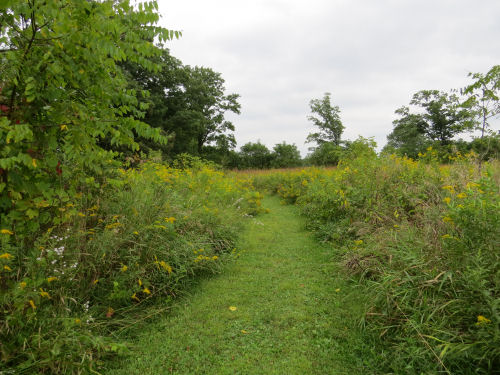
mowed trail through prairie


There is a beautiful visitor's center with nice displays and interpretation of the wildlife. Lake Audubon is an arm of Lake Sakakawea, but it is hydrologically separate because the water level in Audubon is kept the same all year.
Audubon wildlife refuge visitor center


The afternoon hikes were staged to end at the western terminus of the entire trail. The one I chose began at the arch which welcomes hikers to Lake Sakakawea State Park (the westernmost land manager for the trail). There is a bell you can ring to celebrate beginning or ending.
NCT trail arch lake sakakwea state park


And... here are the three muskateers at the actual terminus. My third time here. Marie's second, and Diane's first. The weather was dull when I was here in 2022, so I'm glad to have a picture in nice light.
western terminus NCT


This was followed by a nice dinner with pulled pork and corn on the cob served by the ladies of Riverdale (the local community). After that was a good presentation on the Lewis and Clark Expedition.

The speaker clarified that the reason there are so many pronunciations of Sacajawea's name is because each tribal language had it's own nuances. In the Lewis and Clark journals it's usually Sacajawea or Sacagawea, but in North Dakota, one says Sakakawea!

Always hard to say goodbye to such good friends who care about this trail. We have noted that quite few of the people who have been involved for years are aging out. I think we have some younger folks stepping up to fill in. But, you know, I've been a member since 1995. In that amount of time there is bound to be a serious attrition rate. There were about 90 people who participated, which seems pretty good for an event that wasn't an actual national conference, and was at one of the termini. Those always have lower attendance because of the travel burden. The North Dakota chapters did a tremendous job of putting this together. Major Kudos!

Hiked 4 miles on the NCT in Audubon Wildlife Refuge and Lake Sakakawea State Park.

Miles hiked in 2025: 349.6
Miles hiked on NCT in 2025: 220.6

See Travel Day

Wednesday, August 20, 2025

This Is North Dakota Eastern Edition


Today is day 1 of the Hike Fest.

I went on the 3.5 mile hike in the morning. Most blazes in ND are on posts.
blue trail blaze on a post


People think North Dakota is flat. And it is in certain places, but there are many places where it is more like this-- rolling hills and some trees. These are mostly oaks along the Sheyenne River. This was our first view of the river (the brown stripe down in the valley)
Sheyenne River


This hike went from the Berg Trailhead across a section of private property that has been granted a trail easement.
prairie hike


The chapter has put in a number of new stiles (fence crossings). This design is super! There are steps that go through the fence and you walk up one side and down the other. Other designs work fine, but they are more like climbing the fence.
stile


And why are there fences and stiles? Because there is large-scale grazing of beef on much of the land. This is a good thing because the prairie grasses evolved with the bison, and to keep the native plants healthy they need to be grazed.

The cows are extremely curious. They all ran over to see what we were. But when we climbed into their pasture they ran away like the wind.
cows


The afternoon hike was 6.5 miles from Ekre Trailhead to Jorgen's Hollow Campground. This is within the National Grassland which is marked by posts with an angled top and the NCT emblem.


We arrived at Jorgen's Hollow in time for a yummy picnic dinner, and a few remarks, introductions of people, and the presentation of a few awards. Great fun. There are about 80 people who came to ND to participate.

The mosquitoes were pretty bad, but the worst was the heat. So I hiked 10 miles that were very hot. I know, I know... I should be used to that, but I don't seem to be.

There was really cold water available to drink at the end, so that was nice.

More hikes tomorrow.

Miles today: 10 miles on the NCT in North Dakota.

Miles hiked in 2025: 340.2
Miles hiked on NCT in 2025: 201.2

See North Dakota Here We Are

Monday, April 1, 2024

Summer of 1993 - Prairie Plants

 You'll probably recognize this as a coneflower. But which one, eh? I think it's Pale Purple Coneflower, Echinacea pallida due to the narrow rays. The purple parts- they aren't really petals. This was before I had made my picture-taking rules about getting photos of the leaves.
pale purple coneflower


Here's one you might not know.
compass plant


This is Compass Plant, Silphium laciniatum. It's huge. It can grow from 3-9 feet tall. Definitely a prairie plant, and a famous one at that. It doesn't get it's name for nothing.
compass plant


The leaves emerge from the ground at random angles, but then they orient themselves pointing north-south. Settlers actually used the plant to stay on the correct heading as they crossed the plains. They could feel the leaves even at night.

The leaves may do this to avoid catching the full brunt of midday sun, so they can preserve water.
compass plant leaves


In other news: I worked on my book until mid-afternoon when I sent this draft to my fact-checking readers! Then I played hooky, and went to do a puzzle with Cathy. Got a load of laundry done before it started to rain.

See More Plants

Sunday, March 31, 2024

Summer of 1993 - More Plants

 Today, I have a selection of more plants from the summer of 1993. Again, this is driven only by what I have pictures of. There are some pictures that I can only guess what the plant was. Forget using those! Remember, this was back when you had to have film and wait days to see if you got anything good. And I only had a moderately good camera at that time. It was better than an Instamatic, but I wasn't as careful as I might have been. Or perhaps I was trying to take pictures with one hand while holding Chips with the other. Who knows!?

Everyone loves water lilies. This is the common water lily, Nymphaea alba. It's native, as are all of the plants I'll show you today. It likes water at depths of 1-3 feet, so it was very happy in our constructed ponds.
water lily


Golden ragwort, now Pakera aurea (it used to be Senecio), is a lovely open woodland and meadow flower. One thing that is a lot of fun about this one is that the buds are purple, so it's a big "surprise" when the flowers turn out to be yellow. That also grows here.
golden ragwort


Many of you will likely recognize this plant. It's common in rich woodland of Michigan. This is great Solomon's Seal, Polygonatum biflorum. You can see how the flowers hang in clusters of two, biflorum, under the leaves.
Solomon's Seal


Don't forget Chips... he liked plants too, just usually when they provided nice shade.
puppy under solomon's seal


This one is Golden Alexanders, Zizia aurea. It has a lot of lookalikes, so you have to pay attention to the leaves. The most common mis-identification is with Wild Parsnip. I have to keep looking them up to remember the difference myself. But the Alexanders have compound leaves with 5-7 oval leaflets. Like the other plants featured today, except for the water lilies, it will tolerate everything from wet meadows to woodlands.


My final plant for the day is one I've only ever seen that one summer. It doesn't grow in Michigan except for a couple of odd finds in the SW part of the state. Again, it will tolerate wet or normal soil, but it does like limestone, and is a transition plant from prairie to forest, like the savannahs that were being reestablished.

And, I didn't take its picture. I drew it. The reason I'm not a very good artist is that I don't have the patience. I only drew the flowers, not the leaves. But I know what it is anyway. There are only a couple of choices, and the truly rare one is far west of where I was. This is Shooting Star, Primula meadia (used to be Dodecatheon). I'd love to find more some day. It can grow to about 20 inches tall. I think this one was maybe 12-14 inches.
drawing of shooting star flower


Tomorrow, I have some more flowers. I learned quite a few that summer that I don't have pictures of, but I have a couple of prairie plants.

In other news: I'm trying really hard to get the North Country Trail book ready to go to my advance fact-checking readers. I worked my brain to a mushy pulp today. I think it will be ready to send tomorrow.

See Alien Plants

Thursday, January 4, 2024

Stop Three - Gary

 And... another virtual friendship bites the dust and becomes transformed to an in-person one. This is Gary, a man I met through a Facebook group focused on fiberglass trailers. He helped me overcome so many difficult fixes on my trailer, Sunny! Not only does he have a fiberglass trailer of his own that he did extensive repairs on, he has a lifetime of experience working on vehicles and figuring out ways to do things that aren't standard by-the-book repairs. We have several other things in common, and also a shared faith. Turns out... he also likes jigsaw puzzles. He had one started. Of course, we had to finish that while we visited. The puzzle is called "Cafe on the Water."
man with a jigsaw puzzle


Best happenings of the drive... These are the cooling towers of a nuclear power plant. For one thing, I thought it was just interesting how the steam suddenly flattens out into the cloud layer. Must hit a layer of air that is a different temperature. I also thought the contrast of the high tech power generation with the farmland was interesting. If I'd stopped I could have gotten a much better picture, but I just did a bunch of point and shoot. This is the best one.
cooling towers


If you have any doubts that railroads are alive and well, just come to the plains. Long freight trains loaded with containers are a common sight.
container train


I crossed the Mississippi River today too. There wasn't any real place to stop even if I'd been willing. I did a bunch of point and click attempts. This is the only one worth anything, and you can only see an edge of the river.
Mississippi River


It was almost dark when I got to Gary's house. His neighbor has a small prairie he's restored. There are trails through it. There was just time to take a little walk which was perfect to get out the kinks. Again, not the best season of the year to showcase the plants. but it was enjoyable.
restored Iowa prairie


Just in time for a sunset on the prairie. Then he fed me stew and apple crisp. So yummy.
prairie sunset


Turns out that Gary has a history of many skills using his hands, not just working on vehicles. For a while, he made mountain dulcimers. Here are two of them.
mountain dulcimer


Once more, I'm very happy to have met this person for real. Of course, not every internet "relationship" works out, but I don't think it's all that different from the old "pen pal" idea. Some of those turned into real friendships, and some faded away. In either case, our horizons are always broadened a bit.

Thanks, Gary, for your help and your friendship!

See Stop Two- Ken

Saturday, September 19, 2020

False Indigo

  I'm taking you back to the Baker Sanctuary today for another prairie plant. I wish it had been in bloom because it's a spectacular plant, but it was too late. So you get spectactular seed pods instead. The trick is... exactly which False Indigo is it? false indigo The genus is Baptisia. It would be easier to tell the species if I knew if the blossoms were white, yellow, or blue. But the only real clue I get in September is the shape of the leaves. white false indigo leaves I believe this is White False Indigo, based on the leaves. Baptisia lactea, formerly alba. That means it would have white flowers. Here's what the whole plant looks like. white false indigo And a seed pod popped open. white false indigo Why false indigo? Because true indigo dye comes from plants native to India and SE Asia. These plants also produce a blue dye, but it was considered inferior in quality, thus "false." Indigo was the dye used for blue jeans. Now, it's all made synthetically.
In other news: I did work on the well pit today, and got some stuff done, but nothing really of interest to show you, so that's why I went back to a plant. I wrote a chapter in The Lonely Donkey, and did one of the illustrations.

See Flat-top white aster

Saturday, September 12, 2020

Baker Sanctuary

  The vendor event went really well, and I found a place to take a short hike just a few miles from there on the way back to Chuck and Sylvia's. This is the Baker Sanctuary, through a prairie area and near a marsh. The trails were wide mowed paths prairie path This is a nice prairie landscape. Baker Sanctuary Lots of asters and goldenrod Baker Sanctuary The best find was trumpeter swans in the marsh. But what is that gray lump? trumpter swan It's a juvenile swan! trumpter swan Only two miles, but just a perfect way to stretch my legs. This is just north of Marshall, Michigan. One more day for the event.
See Twelve More Miles