Entries to Win Afghan

Sign up to receive the Books Leaving Footprints Newsletter. Comes out occasionally. No spam. No list swapping. Just email me! jhyshark@gmail.com Previous gifts include a short story, a poem, and coupons. Add your name, and don't miss out!

Monday, September 14, 2009

Monsters and Fairies


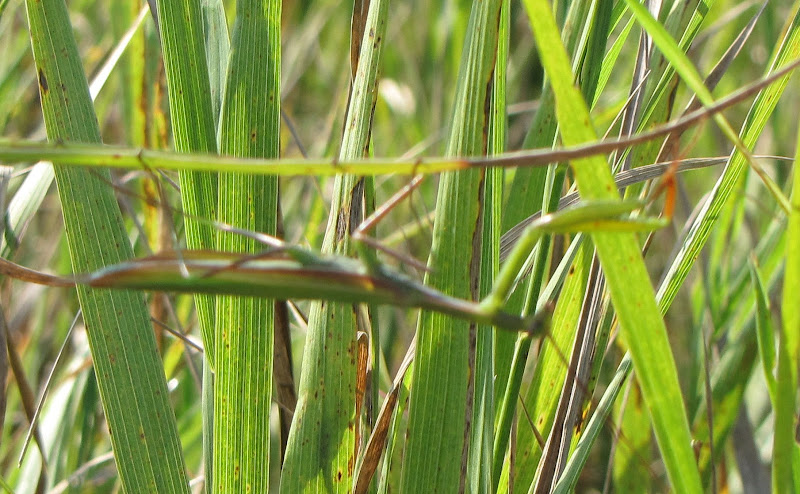
The fairies were still there today! I saw two more flying above the field. Yet, it is the sad truth that when the fairies come to rest it turns out that they are indeed the Tyrannosaurus Rex of the insect world. Who guessed it's identity? praying mantis on grass stem

I sure did not know that when a praying mantis flies that the undersides of its wings are white! Praying mantises are large insects, three or more inches long. They are vicious predators in the insect world. Larger species not native to the United States even eat small frogs and lizards. AND the female eats the male after mating! They will be happy to pinch or bite your fingers if you pick them up too.

The other choice I gave you yesterday was a Katydid. Katydid's are actually related to crickets. They can pinch or bite, but rarely do. I pick them up almost whenever I see them. They are a wonderful part of my childhood memories, even if they aren't fairies. Their name comes from the sound the males make by stridulation- rubbing together of their wings. I remember many summer evenings with the calls of "katy-did, katy-did-did-did" filtering through the screen door of the kitchen.

See A Fariy Tale in Green and White

PS- If you are at all interested in web advertising, would you hop over to Just Throw Money and take the poll about what you think ads on a blog should be worth.

Sunday, September 13, 2009

A Fairy Tale in Green and White


Four days ago I was using the riding lawnmower to mow my walking trails through the fields near my house. As I stirred up the tall grasses many insects were flying around and trying to get out of the way. Suddenly, a large, slim fairy, pale and illuminated, as if it somehow was able to surround itself with moonlight even in mid-afternoon, fluttered away. Its wings were long, and it scurried through the warm air, then dropped into the grass, disappearing.

As I continued mowing, more and more fairies sprang away from my noisy and disturbing activity. Each was that eerie pale white, occasionally flashing gold edges from their backs and wings, as if they flickered between sunlight and moonlight. Who were these mystical, enchanting visitors to my field? I'd never seen them before.

The next day I went walking with my camera, thinking that I would capture a fairy in pixel dust. Wrong! You already knew that you can't capture fairies, right? Well, I did see several of them, but when I took a picture, this is what showed up.

grassy area with trees

So, I found out that you can't take a picture of a fairy! The next day I saw more fairies, and the next day too. Today I saw one more.

I did manage to follow several of the little teasers to where they had alighted. But each time I found the landing place, I discovered that the white fairy had disappeared and left a green monster in its place.

Which green monster do you think the fairy became? Tomorrow I'll tell all!

praying mantis

katydid

Saturday, September 12, 2009

The Secret of the Clammy Ground-Cherry -- Revealed!


I bet you thought I forgot all about my promise to finish the story of the Clammy Ground Cherry. I didn't, but the sneaky plant wouldn't cooperate to share that secret before I went hiking, and I finally got around to checking to see if it was too late, now that I'm home. If you want to catch up on the beginning of the story, go to The Secret of the Clammy Ground Cherry

clammy ground cherry growth habit

Here is the seed pod, matured from its tiny beginnings in July. See it? Maybe you think that it looks like the ornamental plants called "Chinese Lantern Plant." And that would make you very observant! They are close cousins. This plant is Physalis heterophylla, and the ornamental is Physalis alkekengi.

Note on this plant that the seed pod, really just an inflated calyx (the small leaves that grown "behind" the flower), turns golden as it ages. This makes it really look like a little lantern! But this is only half the secret.

clammy ground cherry growth habit

Here we are! Inside each one of those seed pods is one single little "cherry." Note that even though the pod I've broken open here is green, the fruit has become a dull gold. If you open the pod and find a golden cherry you are in for a special treat... they are edible! They have sweet-tart sort of taste, sort of like a kiwi, but unique in its own way. The fruits are sticky, which may be where the "clammy" part of the name comes from. I just like to eat them as I find them while walking. But they can be collected. A friend once made relish from the fruits that was good served with meat.

clammy ground cherry growth habit

See The Secret of the Clammy Ground Cherry

Friday, September 11, 2009

Spermophilus richardsonii


There are about 200 mammals in North America. Although I would certainly never say that I know all of them, I thought that I at least would recognize any from the Northeast or Northern Midwest. Wrong! Here's a little furball that we saw on the Mesabi Trail one day.

flickertail

Appears to be some kind of rodent. OK... holds its tail out behind it, not up, when moving (Chipmunks run with their tails up). There are more rodents than any other kind of mammal. Wonder what the heck this is... some kind of ground squirrel?

flickertail

Speaking of that tail, maybe it needs a little bit of grooming...

flickertail

"Pardon me, this is important"

flickertail

"Actually, it's a little embarrassing... I mean, how would you like to have to clean your tail in public?"

flickertail

"Gotta go!"

flickertail

Well, you can believe that I really was eager to look this one up when I got home! Seems this is a Richardson's Ground Squirrel, Spermophilus richardsonii, often called a Flickertail. It is native to short grass prairie. In fact, North Dakota's nickname is the Flickertail State! (I'm embarrassed to say that I thought that was referring to a bird.) So, we saw this in Minnesota, on the Mesabi Trail.

Supposedly they act more like a prairie dog than like other ground squirrels, and they flick their tails a lot... thus "flickertail."

Well, I'm always happy when I'm learning something new about the outdoors, so this was a 5-star day on the trail!


See New Digs for Peabody's Great, Great, Great, Great... etc. for the local ground squirrel
if you like this blog, click the +1   or

Like This!


Thursday, September 10, 2009

Details, Details

 
inky cap fungus

I love close-up details! It was hard to pick just a few to share today from the August hikes. Hope you enjoy the ones I selected! Above is what I believe to be an inky cap mushroom. They go through several stages of appearance, most of them not nearly as attractive as this. They start out white and columnar, and then the cap starts to self-digest and ends up dripping in a tarry black mess off the edges till it disappears.

On one of our days off we went on a guided tour of Finnish heritage near Embarrass, Minnesota. The township is working hard to preserve the most unique of the remaining log buildings built by the Finns who settled the area. These tight dovetailed cabin corners are typical Finnish handwork. And I do mean handwork... all the cutting was done by hand. The picture below that just captured my fancy. It was not particularly typical for the Finnish barns to have these vents, but I liked how it looked!

Finnish cabin corner

Finnish barn cupola

I just like the colors and shapes in this one!

red maple leaf on rock

Finally, here is the root of a cedar tree hanging on to the cliffs along the Split Rock River.

white cedar root

I just can't leave Minnesota quite yet. I got pix of a mammal that was new to me. That was quite a surprise. Come back tomorrow to see it!


See Parkside to Biwabik
if you like this blog, click the +1   or

Like This!