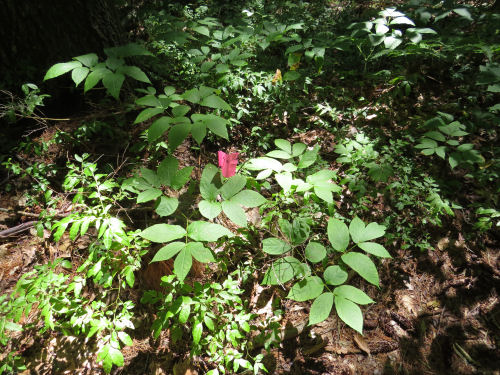
I found Frangrant Bedstraw, Galium triflorum. This time you can tell why it has the triflorum name. The flowers are in little clusters of three. You can just barely see a couple of sets.

This is fairly common, but it's still a fun find. Squawroot, Conopholis americana. It's parasitic on oak and beech, both of which grow at Crystal Valley

But the best find is two more fruiting chestnut trees. One had LOTS of seed pods on the ground.

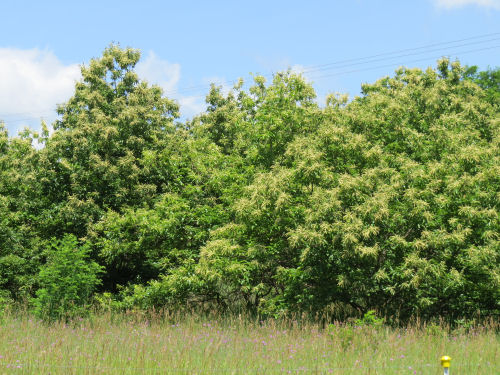
We hunted around for the trees. I think we found one of them. The leaves are w...a...y up there, and this was the best picture I got even with the zoom on my camera. Not definitive. They should be a little narrower for American, but they are definitely not pure Chinese.

The bark is, well..., not very helpful. I did find pictures on line that look like this, but it usually breaks into more separated vertical straps by the time it gets this size. However, this does look consistent with some of the pictures.

So here's the eternal question. Are these American Chestnut, Chinese Chestnut, or a hybrid. They are not Chinese, but they could be a hybrid. This issue for me on this question is that this tree is big and old. It's probably at least 75 years old. The fact that it's tall and straight says American.
Although there were experiments being done with hybrids as early as 1925, one has to wonder why there would be 3 hybrid chestnuts randomly growing out there. But... it is Forest Service property, so I suppose there could have been some kind of experiment going on.
I think it's quite a mystery, and I don't understand why the FS doesn't seem more excited about my reports. Maybe they already know about these and know they are hybrids? If so, I don't know why they wouldn't just tell me that.
We hiked 5.2 miles. Anyway. I didn't sleep well last night, so I'm passing out early tonight.
Miles hiked so far in 2024: 264.5.
Crystal Valley, MI. Parts of loops, 1, 3, 4. 5.3 miles
 | See Bedstraw Bonanza
See |


 This is an approximately 2 mile stretch of the Bristol Branch which also has a return loop so it can be hiked as a round trip. My friend Irene (where I am now staying), and a high school teacher and class, and the naturalist from Letchworth State Park worked together a number of years ago to develop an interpretive booklet and numbered stations. What they produced is quite extensive, and a real resource for teaching. Or, it can be enjoyed more casually by anyone.
 However, plants have a nasty little habit of changing over time. It's perfectly natural. The light changes, or the water table, and plants decide then don't like where they have been growing and die or go dormant. Plants die and others take their place. They grow and shade out other species. It's only nasty if the humans have done a significant amount of work to try to tell other people where they are by means of a booklet.
 I won't bore you with a five-hour botany lesson (how long I spent on about one mile of trail). But I do have some cool pictures. This is a fungal pattern on Yellow Birch bark
 This golden fungus adorned the base of a tree. Not sure what it is.
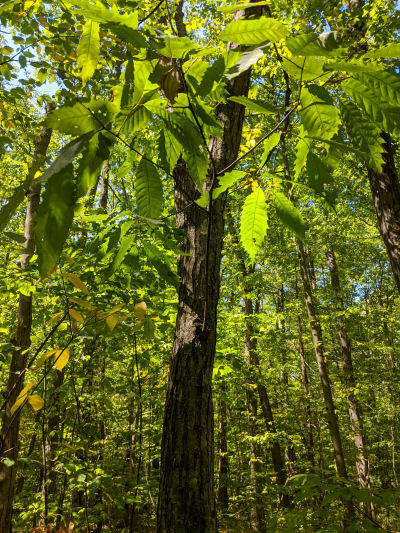
 This is an American Chestnut. There were hundreds of sprouts in this woods, trying hard to make a comeback. Maybe one of them will succeed, and be the forerunner of the genetic winner that will allow the species to overcome the Chestnut Blight. They usually only get a little larger than this one before they die.
 I got half of the sites checked today. I'll need to spend one more day to complete the semi-inventory. (Not a scientifically conducted inventory, but a better-than-casual attempt.) And it will also take about 2 days to get the data collected so Irene can use it to have the booklets remade.