Entries to Win Afghan

Sign up to receive the Books Leaving Footprints Newsletter. Comes out occasionally. No spam. No list swapping. Just email me! jhyshark@gmail.com Previous gifts include a short story, a poem, and coupons. Add your name, and don't miss out!
Showing posts with label false morel. Show all posts

Sunday, May 10, 2020

Gyromitra Parade

 
Surprisingly, I've see three false morels this spring. Maybe three different kinds. Maybe only two. Maybe I know what I'm talking about and maybe I don't. Anyway.

Gyromitra are all false morels. Mostly they shouldn't be eaten. Some people are apparently able to tolerate the ones that are sometimes called "beefsteak," but now that the chemistry is better understood, I'm sure not trying any of them.

This one is probably Gyromitra esculenta, often called brain fungus. You can see why. In some places people eat these after boiling thoroughly. But they release volatile hydrzines which can affect the liver, kidneys and central nervous system. This picture was taken May 2.

Gyromitra esculenta

This one is probably Hooded False Morel, Gyromitra infula. I have to say "probably," because I'm not good enough on mushroom ID to know what to look for. I should have checked to see if the stalk was hollow, solid, or full of filaments, taken a spore sample, etc. But I was hiking, not botanizing. Sometimes it develops an interesting shape that results in the common name of elfin saddle. Picture taken May 4. They usually fruit later in the season, but it's not unheard of to find them in the spring.
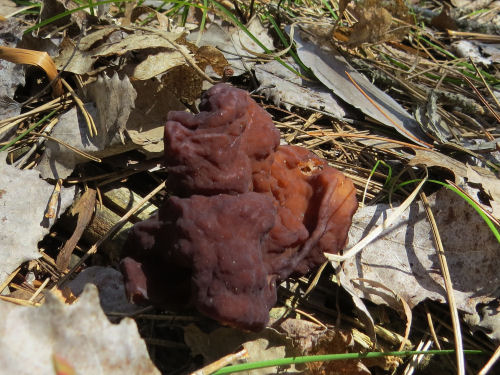
Gyromitra infula

And here's another. Or another one of the same thing as one of the above. As you can see it's lighter in color than the G. infula, and not as convoluted as G. esculenta, but that doesn't really mean anything. They have a range of colors, and they darken with age. I didn't even look to see if this one had a stalk. Picture taken April 24. The dark one above did have a white stalk.

But, you are safe to just call them all false morels. You are probably a lot less safe to eat them. Less safe than going out in public in these days of the virus.

Gyromitra false morel

In other news: I worked on one of my many projects in the morning, and then switched to hiking maps in the afternoon. I finished the maps, and have now started redoing the Data Book for the trail to make it more useful.

See Fun Guys Wear Brown
if you like this blog, click

Like This!


Tuesday, April 13, 2010

Fun Guys Wear Brown


The good stuff just keeps coming at this time of year! These pictures are from the hike on Saturday, but I took a video today that I've been trying to get since I have had a digital camera. And it came out really well! So I'll have that for tomorrow. I'm also really excited about something that is going to occur tomorrow evening. A lady who knows frog voices well enough that she is an observer for the state frog surveys was on the Saturday hike, and taught us to recognize the chorus frog. It is the one that sounds like you are running a thumbnail over the teeth of a comb.

She is taking me with her to Sterling Marsh tomorrow evening, and we are going to listen to frogs. I am going to try to capture some of the sounds. I can recognize several kinds, but not nearly enough.

Now for the brown fungi. Oh, you expected brown clowns? Nope.

calf brain fungus

This odd looking thing is called calf brain mushroom. It does have a stalk, but I didn't do a good job of picturing that. It's actually a false morel. At this time of year people are starting to look seriously for the true morels, a mushroom that is highly popular to eat. It's easy to identify so people don't make fatal mistakes with it, which helps its popularity too. You don't want to eat this one though.

hemlock polypore

This one was spectacular! It's hemlock polypore or hemlock varnish shelf, Ganoderma tsugae. It will grow on other trees, but definitely is most likely found on decaying conifers, with a special fondness for hemlock. That's what it's growing on here. Here is the underside of another one of the "shelves". Yes, it's called a shelf fungus.

hemlock polypore

I know, that's not so interesting, but you can see that it doesn't have gills. That is one of the characteristics of the polypores. Instead of gills they have many pores... polypores.


See The Power of Nature for another polypore
See Details, Details for an inky cap fungus