Entries to Win Afghan

Sign up to receive the Books Leaving Footprints Newsletter. Comes out occasionally. No spam. No list swapping. Just email me! jhyshark@gmail.com Previous gifts include a short story, a poem, and coupons. Add your name, and don't miss out!
Showing posts sorted by relevance for query pitcher plant. Sort by date Show all posts

Tuesday, March 15, 2011

Another Dark Plant and its Siblings


dark pitcher plant

Here' another dark plant from the Philadelphia Flower Show. It's a pitcher plant, Sarracenia x chelsonii, which is a carnivorous plant. These are the flowers, but the leaves are modified into open tubes in which water collects. Insects are attracted into the tubes, which also have downward pointing hairs, so the insects can get in, but not out. This is a hybrid- fooled with on purpose to make an ornamental plant (and this one won a blue ribbon). Want to see what wild pitcher plants look like? OK!

wild pitcher plant
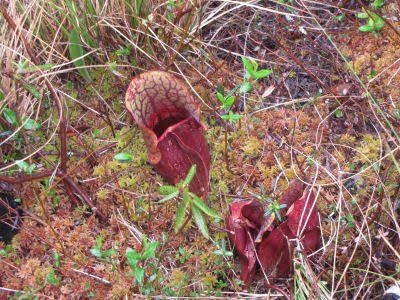
Here is the flower- the same as the dark showy part of the plant above. If you look at the one from the flower show you can see the tubes coming out of the pot. They are green. Here are the tubes from the wild one, which is Sarracenia purpurea.

wild pitcher plant

Quite beautiful, don't you think? These wild ones were growing in the Upper Peninsula (Michigan) last year. I give it a blue ribbon, too. I learned something else when we took those pictures too. Look at what that blossom is hiding, when it's turned up.

wild pitcher plant

I sure never expected the two-toned effect.

ornamental pitcher plant

Here's another ornamental variety from the Flower Show. It's called Amber Rays. Later, I found yet another one at the Flower Show, but I don't know what variety it is, but the curly petals were really odd.

ornamental pitcher plant

It seems weird to me that a bog plant (an acidic wetland) should become a popular ornamental plant. But that has obviously happened. And they are beautiful. But the wild ones aren't exactly shabby, either!


See Philadelphia Flower Show 2011 - Dark Plants 2
See Philadelphia Flower Show 2011 - Dark Plants 1


Thursday, November 7, 2019

Meijer Gardens - Carnivorous Plants

 
I'm not going to be able to identify all these perfectly. Not all had labels. But there was a great variety of carnivorous plants.

We have native pitcher plants, Sarracenia purpurea, that look very much like this one, but it wasn't labeled, so I'm not positive. Pitcher plants lure insects into the pitcher where they drown and are then digested.

pitcher plant at Meijer Gardens
However, most of the pitcher plants were native to the tropics. Many of these are trees. This is Nepenthes bicalcarata, native to Borneo. Common name Fanged Pitcher Plant. Look under that little hat and you'll see why.

fanged pitcher plant at Meijer Gardens

fanged pitcher plant at Meijer Gardens

The variety of tropical ones was interesting, although I don't know enough to know if there were many species or just variations of a couple.

This was identified as Red Leopard, a cultured ornamental of Nepenthes sp.

red leopard pitcher plant at Meijer Gardens
Here are two more- one with that red lip, and another with toothed combs.

tropical pitcher plant at Meijer Gardens

Everyone can recognize a Venus Fly-trap. Of course there are lots of species. This one is the common one you can see in the wild, Dionaea muscipula, although a very healthy one. The ones I've seen in swamps are much smaller. They, snap closed when the hairs are mechanically triggered, and they then digest the insect captured.

Venus Flytrap at Meijer Gardens

Of greater interest to me was the Sundew growing in front of it. I've seen two kinds in the wild, this one is different. There are almost 200 species, but only a few grow in North America. I believe I've figured out that this is Drosera adelae, Lance-leaved Sundew, native to Australia. Notice the strap-like leaves. And... it was blooming, with these beautiful tiny red flowers. Sundews have sticky pads on the edges of the leaves to trap insects.

lance leaved sundew in bloom at Meijer Gardens
And, I learned something really new. I was not aware there is a carnivorous bromeliad. It also lures insects with a sweet odor and ultraviolet colors to a watery death in a slippery leafy cup. Brocchinia reducta, no common name, and native to South America. It was also blooming.

brocchinia reducta at Meijer Gardens
Hope you enjoyed the tour of this dangerous room (if you are an insect!).

In other news: I wrote in the morning, and spent the afternoon getting organized to leave for the two-day show in Cedar Springs. The trailer is hitched up, and I just need to put some things in it that I need for sleeping and food. It's going to be cold, but, oh well.

See Outside Details
if you like this blog, click

Like This!

Friday, March 15, 2019

Philadelphia Flower Show 2019 - Interiorscape

 
There was one other contest at the 2019 Philadelphia Flower Show that involved a model living space. This was called an Interiorscape, and the guidelines state "In the Mood, an interior room with live plants, inspiring any mood with color, texture, and fragrance."

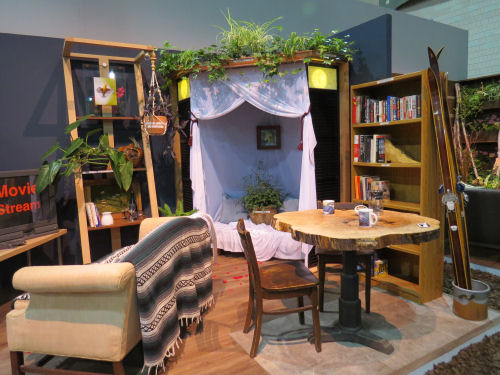
Again, there were two judgings, and the results were mixed. This was my favorite, and it took 1st on Friday and second on Wednesday. Its title is "In the Mood for Moose." The intent: "There is something magical about Maine's seasons... A rustic cabin is perfect for the many moods of Maine."

Judges comments: "Execution of intent hits the mark." and "Restful design. All plants beautiful. Less would be more."

Philadelphia Flower Show 2019- interiorscape

Next I'll share the one that flip-flopped with the one above, taking first on Wednesday and second on Friday. It's called "Color! Life! Creativity! The intent is "I love to escape to my plant filled studio and watch the ideas grow on canvas..."

Judges comments: "Variety of well-conditioned plants is suited to artist's display. More variation in scale would enhance exhibit." and "Design calm and restful. Cohesive use of plant material. Excellent use of accessories. Colors blended well."

Philadelphia Flower Show 2019- interiorscape

In a solid third place for both days was "Let the Sunshine In." Intent: "...one more mid-term and I can be excited. Are you packed? Cannot wait to lie in the sun..."

Judges comments: "Spectacular flower power. White floor distracts." and "Joyous use of color. Potted plants are horizontal. More vertical plants would help with design."

Philadelphia Flower Show 2019- interiorscape

And taking fourth both days was "A Road to Romance." Intent: "Romance is a construct that resides primarily in the interior of our minds... The distribution of plants represents the growing impulse to create new life, from paucity to plethora."

Judges comments: "Good use of textural elements. Additional plants and color would be welcome." and "Plant materials good for living indoors. Furniture overpowered plant material."

Philadelphia Flower Show 2019- interiorscape

I really liked "In the Mood for Moose." The plant materials were cleverly chosen, with staghorn fern mimicking the antlers, and the moss and pitcher plant bouquet looking like good moose habitat.

Philadelphia Flower Show 2019- moss and pitcher plant

In other news: I wrote in the morning and did some odds and ends after that. Then I gave in and read for fun. Yesterday I walked in the rain, and today in the snow. But at least I walked!

I spent some time pondering how one becomes a "best selling author" on some media's list. Did a little research and part of the answer is that you throw a whole lot of money into advertising. Well, that's not going to happen. But I did discover that "The Hollow Tree at Dead Mule Swamp" is consistently in the top 100 of Kindle Store > Kindle Short Reads > 90 minutes (44-64 pages) > Mystery, Thriller & Suspense. That's a start, I guess. But I need to somehow move things along faster, or I'll have to give up on the "author only" job description.

See Balconies
if you like this blog, click the +1   or

Like This!


Monday, March 17, 2025

Philadephia Flower Show- For Peat's Sake

 This was another of the Standard Flower Show contests at the Philadelphia Flower Show 2025. The assignment was to create a "pocket garden that encorporates a bog garden area."

We need to start with defining a bog. A bog is a wetland that is acidic, and it will support particular kinds of plants.

Oddly enough, the blue ribbon entry is titled "The Mysterious Fen." Now, let me explain that a fen is also a wetland, but it is the opposite of acidic; it is basic. Completely different kinds of plants grow in a fen.

I have to confess that I was rushing so much to take pictures of entries that I did not stop to examine the plant material carefully; however, what I can see and ID is not necessarily suited even to a fen. The corkscrew rush is pH normal to acidic. Most of the other plants I may be figuring out are from all over the world, and would never be found together. The intent even says that: "an enchanting convergence of native and foreign growth- a mystical vortex."

The judges said, "Wonderful composition."


Second place went with something more realistic titled "Guardians of Tomorrow." This depicts the cedar bogs of New Jersey, and states "the reddish-brown watery bogs of New Jersey's Pinelands are our protectors." Well... this warms my heart because that is exactly the kind of thing I was studying for many years.

The judges said, "Wonderful use of bog plants."


Everything you can see even in this corner is really is a bog plant. Two kinds of pitcher plant, a flytrap, haircap moss, wild cranberries, and a clubmoss.


Third place is "Through the Pitcher Window." This is a play on words, with a lot of kinds of pitcher plants- reminder: these eat insects. The intent says, "Pete reflects on his carnivorous plants in his peat rain garden."

The judges remarked on the varieties and quality of the various pitcher plants, but thought the window was out of proportion to the exhibit.

Note, there is a pitcher of purple pitcher plants that you can see through the picture window.


There were three more entries which all got honorable mention.

This one is called "Whimsical Wetlands," and the judges thought it could be more "robust." It is pretty realistic, but not much artistry.


This one is called "The Mystical Side of Nature," where "magical plants sway eerily in the evening."

The judges said is was "enchanting," but the azalea was not suitable. Well, there are native azaleas that do grow in bogs, but this is just a commercial one, although they all prefer acid soil. This would certainly have done better if they had used a different azalea because the ferns were carefully chosen and the garden is colorful.


The last bog garden was called "The Living Canvas" which "invites relaxation and reflection."

The judges said it was a lovely collection, but that the houseplants were not suitable." I have to agree. There is nothing about this that says "bog."


OK, at a flower show where I am Queen, the New Jersey Bog would have taken first place for having actual bog plants, the diversity of native plants, adhering to the theme of the entire Flower Show (Gardens of the Future), and having the structural element (the log) at a diagonal instead of straight (the rock stream) in the one that took first place. So there.

I was sort of tired all day. I didn't sleep well. My head and face were itching like crazy and I took an extra pill and got out the ice pack again. This is all very normal for the neuralgia, but there is no way to know how long it will continue.

I puttered at various jobs and took a tiny walk that doesn't even count.

See PFS- Lab to Landscape

Friday, June 18, 2010

Wet Again and Bogs- June 9

 
It started raining in the night again, and we awoke with a cold, misty rain blowing. Most of the day we alternately crossed small hills and bogs. Bogs are special, acid wetlands where specific types of plants are found. Today we enjoyed the pitcher plants. Insects crawl down those big tubes to get water which has settled in the bottom. But downward pointing hairs prevent them from escaping, and the plants then digest the insects.

pitcher plant

They were in full bloom!

I've seen them blooming before, but often in the wild the colors aren't all as vibrant as the ones we saw. The tubes can vary from green to the deep red shown here, and the flowers are red to purple-ish, with tones of green too.

The stems are quite stiff, and you'll never see the view below unless you turn a flower up to look at the other side.

pitcher plant

By late afternoon we were completely dried out when a thunderstorm blew up! So we walked into camp at Culhane Lake completely soaked again. We set the tent up as fast as possible, threw our wet packs and selves inside, and tried to sort it all out in a cramped space. It did stop raining before nightfall, so we hung the wet clothes outside, and were actually able to cook a dinner.


Wednesday, June 13, 2018

A Few More Matthaei Flowers

 
I think this will be the last day for Matthaei Botanical Garden pictures. But I just want to show these few more.

This was a new one to me. Maybe you plant clock vine in your planters. I like it too. But I did not know there is a blue clock vine, Thunbergia battiscombei, native to Africa. Kinda funky, and my color.

blue clock vine

Next up is a prairie plant. Although it doesn't look as if the restored prairie is being tended much these days, there was one thing in bloom. This is false indigo, a nice showy prairie plant. Baptista leucantha

prairie false indigo

I have to show you this, because it's pretty awesome. This is a really rare and endangered plant, the Pitcher's thistle, Cirsium pitcheri. I showed it to you once before. I found it growing naturally at Arcadia Dunes last year. That was my first time to ever see it. Although it was certainly planted at MBG, the fact that it seems content to grow, and has buds here is pretty awesome. Having multiple populations of endangered species is a really good thing. Yes, it's that scraggly, silvery tall plant in the middle.

Pitcher's thistle

Finally, just because I showed you this once before, I have Malaysian orchid tree, Medinilla magnifica. This was in the Conservatory, of course. This one was labeled, so I've confirmed that's what it is.

Malaysian Orchid Tree

Love, love, love visiting great botanical places. One more coming up soon. Stay tuned!

In other news: my computer was being bad this morning, so I didn't finish some things I started. But in the afternoon, I buckled down and wrote two chapters in The Bigg Boss.

See Arcadia Dunes- Pitcher's Thistle
See Stan Hywet-Medinilla
if you like this blog, click the +1   or

Like This!


Saturday, June 14, 2025

Day Three- Mud and More


Here we are with our spotting crew for these first three days. Sarah is middle back and Lisa is on the right. We are blogging from their cabin, and showering so we appreciate that.
friends


We were checking out an alternate NCT route that doesn't deal with the broken bridge. NY DEC doesn't get around to fixing things too fast.

This is Woodhull Creek (not Little Woodhull). It's truly beautiful, but this trail follows a snowmobile trail. That's not a problem when things are frozen, but it was sphagnum squishy and full of wetland plants which are lovely but scratchy for walking through. We stumbled along for a half mile in that before the trail went into higher ground. The deer flies were fun too.
Woodhull Creek


If I'd had time to botanize, there were tons of neat plants. A nice clump of pitcher plant.
pitcher plant


We ate lunch at the Sand Lake Lean-to, a nice clean one. Sand Lake Falls is right in front of it.
Adirondack shelter


After that it was continual mud pits for a 3.8 miles. But we saw a lovely frog.
leopard frog


It was very difficult walking. That said, we finished at 4 pm. We logged 20 inventory items. I explain more about that another day.

North Country Trail, NY Adirondacks, Little Woodhull Trailhead to Gull Lake Parking. 11.5 miles

We start backpacking tomorrow for three days. Definitely will not blog until the 17th.

Miles hiked in 2025: 242.8

Miles hiked on NCT in 2025: 124.6

See Day Two- Across THE Bridge

Friday, June 20, 2025

Day Nine- to South Lake


Getting ready for another two days of backpacking. Diane fed us french toast and sausages for breakfast (early). We are living pretty high on the hog. Worst part of the morning was that it rained quite a bit during the night, but things looked like they were going to improve for the day.
camp breakfast


It took three hours to spot the cars. Only 17 trail miles, but not many roads to connect them. Along the way, we had to do more tree clearing. Some sawing of limbs again (do we get paid by the road commission?), but one place there were chunks of a broken limb in the middle of the road. I hopped out to sling them off the side and discovered a small semi-casualty of the fallen limb.

It seemed to be only dazed, but barely able to fly, if at all yet. I think it's a chickadee. We moved it to the side and hope mama comes to find it.
baby chickadee


This kind of landscape looks so much like northern Minnesota. Not a lot of places like this, but interesting.
bare rocks


This wetland seems to be on the way to becoming a bog with mats of sphagnum moss collecting on the surface.
wetland


A beautiful pitcher plant in full bloom.
pitcher plant


Our main goal was to get past South Lake. This is a favorite spot of mine just because the bridge is so weird. It spans the lake, and it was damaged somehow in the past (ice?) so it's all at crazy angles. But it's sturdy, just slopey.


It was the weekend, and we saw some other hikers. Two were notable in that they seemed to not have a brain between them. They knew where they had started hiking (where we were headed), so I knew what trail they must have followed. (But they didn't know where they were hiking to.)

I asked them if they had crossed South Lake bridge. (It was less than a mile behind them). They had no clue. I ask you, "Is not that bridge memorable if you had just crossed it?" Anyway... we had hoped to stop for the night at West Canada Creek shelter. But the other hikers thought it was occupied.

So we were walking along trying to decide where we wanted to stay when this campsite appeared beside us. We had no problem making the instant decision to make it ours.
campsite


We only hiked 8 miles, but they were difficult. Lots of mud and rocks and a big climb. We were happy to eat dinner and crawl in the tents away from the bugs. However the weather was great. We are being smiled upon.

Miles hiked in 2025: 282.3
Miles hiked on NCT 2025: 166.1

New York, Adirondacks, North Country Trail, Indian River TH to just past South Lake, 8 miles

See Being Flexible