Entries to Win Afghan

Sign up to receive the Books Leaving Footprints Newsletter. Comes out occasionally. No spam. No list swapping. Just email me! jhyshark@gmail.com Previous gifts include a short story, a poem, and coupons. Add your name, and don't miss out!
Showing posts with label moths. Show all posts

Wednesday, August 12, 2026

White-Lined Hummingbird Moth Again

 The last time I got any pictures of one of these was in 2013, so I was really happy to have one flitting around the yard today.

They move so fast you can hardly get a picture. There are several hawk moths, or hummingbird moths. They are big- 2-3 inches across. And although they look similar, the two you see most often are in different genera. This one is Hyles lineata. They are in the same family. Here are my best pictures from today. The other one has clear wings.
White Lined Hummingbird Moth


That was its back. Here is the side view.
White Lined Hummingbird Moth


And the ventral view. This one was out in the daytime and hanging around white flowers. Supposedly they like bright colors in the day, but white flowers at night. So my Moon Garden may attract them when I get more flowers there.
White Lined Hummingbird Moth


I did all the usual things. Of course went to the hardware store to exchange the wrong part I bought Monday for the correct part. Job not done, though. Zoom meeting this evening.

Many frustrating things, but that is not what this blog is about! Tomorrow I head for Paradise and the Wild Blueberry Festival with too few books because the order did not arrive.

See White-Lined Hummingbird Moth

Tuesday, May 13, 2025

Associated Wildlife


Over the past few days I've seen a number of critters hanging out in the garden. One new to me, one ID surprise, and two that I love. There are lots of bees, cabbage butterflies, and small pollenators too.

This is a black swallowtail butterfly. It kept swooping from the flowers to the post and back. The best picture is on the post, and look at its body! This is the first time I've gotten a picture where you could see the spots on the body.
black swallowtail butterfly


Here is the one that was new to me. These two moths hung out on the sea thrift for a couple of days. Turns out they are the Toadflax Brocade Moth. It is introduced in the United States to try to control common Toadflax, often called Butter-and-Eggs which is a wildflower that I really like, but it is invasive and can be a problem in pastures when it crowds out better grazing plants.
toadflax brocade moth


Here is the ID surprise posing on my jeans. I thought maybe this was a different kind of ladybug instead of the horrid Asian Ladybugs (beetles) that are everywhere now. Ha! It's just an Asian one without spots on its wings. I hate those stinky things.
asian lady bug with clear orange wings


And another welcome visitor. This one tried to commit suicide by jumping in a bucket of water from which it could not get out. I found it floating and looking quite dead, but as soon as I fished it out, it sat up all perky! It was a tiny Gray Tree Frog. I see these around here quite often. In fact, I blogged about one just last summer at Eviction!.
gray tree frog


It was overcast in the morning, and was an excellent temperature to work outside. I did mega yard work, including finishing the first mowing (except for some edges where I need to trim bushes to get the mower close). I do have to do something serious about the mower seat, but I may have a plan figured out.

Also did my editing and went to bell choir practice. The last performance of this season is Sunday. Oh, and I stewed a big pot of rhubarb.

Tired, but satisfied with the day.

See Black Swallowtail Butterfly

Thursday, July 8, 2021

Lesser Maple Spanworm

  Hundreds of these tiny moths were flitting around on Saturday when we were hiking. Someone asked if they were the gypsy moths. I knew they were not that, but I didn't know what they were. Now I know. Can you find the moth? lesser maple spanworm moth

Here is the moth- it's less than an inch across. Cute litte guy. It's the Lesser Maple Spanworm, Speranza pustularia. Their caterpillars are one of the little green inchworms. They prefer maple, but will also eat birch, cherry, poplar, fir, hemlock and tamarack. Not really a problem caterpillar/moth. lesser maple spanworm moth

It turns out you can narrow down the group to ID a moth based on how it holds its wings when resting. And for your reference, gypsy moths are much larger- an inch or more in length, and they hold their wings back farther so their resting shape is more of a triangle. The female gypsies are white with a furry head, and the males are light brown. Feel free to squash any of those when they start emerging!

In other news: It ended up not raining, but it was damp and looked rainy all day so I did not paint. I worked on computer stuff and accouts and errands, and blah blah. Spent all day doing half my potential list. What else is new? No info on the baby phoebes. I haven't seen them trying or succeeding to fly, but I haven't really been watching. Mom and dad have been around as usual and don't seem frantic.

See Hike Day

Thursday, July 9, 2020

Banded Tussock Moth

 
I know I said I'd have something done on the trailer to show you, but I decided I had to add another step, and so there wasn't time to finish it.

Instead, have the Banded Tussock Moth, Halysidota tessellaris, also called the pale tiger moth. He's saying hello.

Banded Tussock moth

Here's the really odd thing. When I unfolded my sheet of fiberglass mat a few days ago to cut off a strip, 5 of these moths flew out. What the heck would they like about fiberglass?

Anyway, I thought they were just white.

Banded Tussock moth

Look closely. There are actually pale bands wiggling across the wings. And a definitive characteristic is the two aqua bands you can see on the top of the thorax.

Banded Tussock moth

The caterpillars are furry, with long "pencils" of hairs sticking out. I thought I had a picture of one, but can't find it tonight.

A much more interesting moth than I thought at first.

We did not get a lick of rain at my house. They did get rain in Scottville, a mile away. There may be hope for some yet tonight.

See True Blue Gumby II

Wednesday, June 10, 2020

Eight-Spotted Forester Moth

 
Today we have some better pictures of a moth I showed you before. That one was in Ohio. This one was literally at my door.

This is the Eight-spotted Forester Moth, Alypia octomaculata. It's a Noctuid moth, and many of the caterpillars are army worms and cutworms. The caterpillar for this one, however, is gorgeous. I've never seen one. The moth is distinctive, with the red/orange leg patches. You don't have to sort through six pages of Lepidoptera that pretty much look alike to identify it.

eight-spotted forester moth

eight-spotted forester moth

Wikipedia says they feed on Virginia Creeper.

In other news: I gardened a little and then started another project related to the upcoming hike. I had to do some cleaning and sorting in order to be able to work on this. You'll see it tomorrow.

We got a little thunder and some sprinkles from the storm that hit harder south of us.

See Eight-Spotted Forester in Ohio

Thursday, May 28, 2020

Sad, but Fascinating

 
The other day, Om was out cutting some grape vines and brush that keeps trying to grow up the side of the house. When he came in, I looked across the room and saw a funny dark thing on his pants. "What's that?"

emerging sphinx moth

I'm pretty sure it is a hawk/sphinx/hummingbird moth that has just emerged from it's cocoon. But the sad part is that if lepdopteria are disturbed before their wings have filled with blood and dried, their wings won't "unwrinkle" properly and they can never fly.

emerging sphinx moth

Well, darn. It was already disturbed, and it sure couldn't stay on Omer's leg indefinitely. I tried to get it to crawl on something without touching its wings, but it wouldn't move onto a hard surface. It did crawl on my finger. That allowed me to get a picture of the underside.

emerging sphinx moth

However, I'm still not sure exactly which moth it is. It doesn't have the white lines of the common one. The pictures I took of the dead clear-wing don't have those bands on the underside. There aren't all that many choices in North America. Without the wings open, it's really hard to tell what it will look like.

I put it on the old wheel. Hours later, it was still there. It was alive, but its wings were not opening. It disappeared overnight- probably becoming something else's meal.

emerging hawk moth

In other news: I worked on the menus for my upcoming hike a bit. Should have done more, but I was a sloth. However, we finally got rain this evening, and the air is less heavy. Supposed to be cooler tomorrow which should help my work ethic.

See White-Lined Hummingbird Moth
See Clear-wing Hummingbird Moth

Monday, April 20, 2020

Two Puzzles Solved

 
Today was super windy again. I went for a road walk this afternoon, and came across this little guy crawling across the blacktop.

Virgina ctenuchid caterpillar

It's not a good idea to touch hairy caterpillars. Many of them can cause skin irritation or rashes. But I touched it with a small rock and it rolled up.

Virgina ctenuchid caterpillar

I had to get some help to identify it. Turns out I also took a picture of one in March of 2016. That one was paler, but clearly the same kind of caterpillar. And also crawling across the blacktop.

Virgina ctenuchid caterpillar

Turns out it's a moth one actually sees fairly often, although I don't have a picture of one. If you've seen the sleek, smooth moth about 1.5 inches in length that has blue-black wings and an orange head with feathery antennae, this is the caterpillar. It's called Virginia ctenuchid. (say ten-UH-kid). You can see one on Bugguide.net

Puzzle one solved!

Puzzle two... This may be a first. Given my history with puzzles, I'm not sure it is, but I don't recall ever doing this. Although my murder-mystery puzzle has 1000 pieces, it was pretty easy. I completed the entire puzzle yesterday! The picture is not the picture on the box at all. You read the little book, and then find the clues in the puzzle itself (mostly the written notes you see on the countertop), and solve the mystery. It was fun.

jig saw puzzle

In other news: Well, my road walk was 6.6 miles, so that took a while. Other than that I worked on some of my personal and volunteer projects. Oh yeah... a cleaned up the kitchen a little bit. It's hard to care. I know you clean freaks don't get that, but I'm basically a slob.

See Puzzle Puzzle

Thursday, June 6, 2019

Scorched Wing Plagodis

 
I saw this moth almost a month ago, when I was camping with Annie, but I'm just getting around to identifying it. It's just over an inch wide. I'm waiting for confirmation from a couple of insect sites, but I'm pretty sure it's Plagodis phlogosaria, the scorched wing or straight line plagodis.

Plagodis phlogosaria

Apparently this is a pretty common moth of North America, but I don't recall seeing one before. For sure, I never tried to identify one before. After looking at a lot of pictures, I can tell you it seems to come in quite a variety of earthy hues, but that straight line across both sets of wings is consistent.

One web site shows the closest verified sighting near Chicago. I'm waiting to hear from them. If I'm wrong, I'll change the ID here.

The species name "phlogosaria" is from Greek phlogos, meaning flame. You might recognize the root word in the somewhat familiar phlogiston, which early alchemists thought was an element released in fire.

In other news: I wrote in the morning, did laundry, wrestled a 4x8 sheet of plywood out of the barn and up to the trailer, took the 16 nails and screws out of it. Then I worked on the photos from the hike I'm writing about. What a job! We had two cameras, and more or less just grabbed one when we wanted a picture. I'm trying to get them in something close to integrated order. No time stamps, of course. This was a year before I went digital.

See Plume Moth
if you like this blog, click

Like This!


Monday, April 29, 2019

Bread Day and a PSA

 
No promises that I can keep this up, but I did manage to make another batch of bread. I thought these loaves might come out better than the last ones. I identified a potential thing I could tweak, but it didn't help. They aren't bad, but I never can seem to get my bread to rise quite enough. But this recipe is better than some I use, and it tastes good.

homemade bread

However, it turned out to be a much bigger project than I had in mind. I wanted to add a little rye flour, which meant I need to get into my "grains" tub.

Notice up front- if you don't like bugs, just back away and wave goodbye.

But we have a horrible problem with grain moths. Plodia interpunctella, also called indian-meal moths, pantry moths, flour moths, etc.

I thought I had everything in this tub sealed adequately. So I opened it up to find the rye flour, and as you can see, there are moth bodies down among the packages, and even a worm in the groove at the top edge. (Not to mention frass- moth poop)
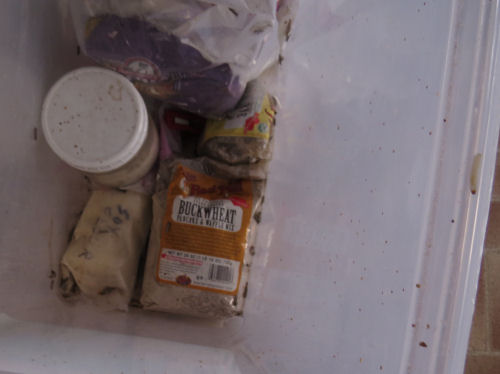
tub with packages of flour and grain moths

I'm not going to try to tell you how to get rid of grain moths. I've decided it's impossible once they get established. The moth traps are too small- they are expensive and they fill up. All of this comes under the heading of management. We kill them whenever we can. They fly fairly slowly and we are adept at clapping them dead in midair. We try to keep everything sealed (although they can get even into screw-top jars. I'm convinced the moths lay eggs at the edge of the lid and the tiniest of the larvae can crawl up the threads.) We keep a strip of flypaper hanging in the kitchen. I know it looks gross, but these buggers do a lot of damage to food, and I need to keep trying to get rid of them. I put anything in the freezer if I think it's got eggs laid in it.

So far, I have found exactly two things that keep them out. I bought a small tub with a really tight rubber seal that I keep my everyday flours in.

And, what I verified today. Here's what doesn't work. Regular weight store packaging, like the inner liners of cereal boxes, plastic bags that specialty flours come in, etc. Even if I seal them with my heat sealer, the worms are able to eat through the plastic to get to the grains. For example: Note the horrible larval mess inside this bag that was heat sealed.

packages of flour with grain moth damage

So, that one went in the trash.

And here's a Ziplock vacuum bag. Do they even sell these any more? These don't seal well enough. Again- see larvae on the inside. Trash.
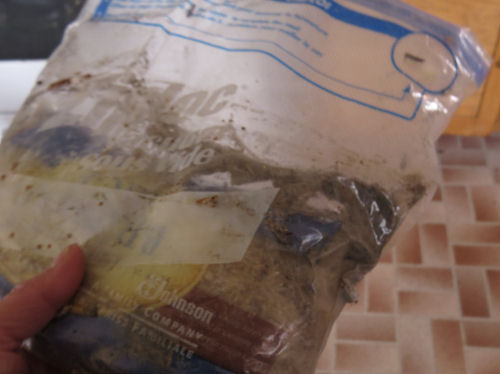
bag with moth larvae inside

Now for the success story. So far, I've never found one of the real vacuum sealer bags that they could penetrate. Every package that I had closed up in a vacuum sealer bag was OK on the inside. Had to clean off the outsides, which I did with the vacuum cleaner and then a wash with hot soapy Clorox water, but the contents are fine.

vacuum sealed bag excludes grain moths

New rule for self: Nothing goes in that tub unless it's in a vacuum sealer bag.

Here's the kind of sealer I'm talking about, and the heavy bags on a roll that come with it, or you can buy separately. Mine is Food Saver brand, but there are others.

Food Saver bag sealer

So, the bread is made, the tub is cleaned, the vacuum is emptied and the trash is gone to the curb- get those moth generations out of here! This job was not originally on today's list.

In other news: the next chapter will be a long one. Long hike, journal hadn't yet been transferred to digital. That is now done. That was my big writing accomplishment for the day. And I'm working on my program that I give tomorrow night about self-publishing.

See Chilly Day Comfort
if you like this blog, click

Like This!

Saturday, May 5, 2018

Luna Moth

 
I am safely at Loretta's, but spent all day in the car, so this is a good time to share our fantastic wildlife sighting with you. I have not seen a luna moth in the wild since I was a child. I have never, EVER, seen one freshly emerged from the cocoon with bright colors like this.

luna moth freshly emerged from cocoon

Let me tell you how we found this beautiful boy (more on gender later). We were about halfway up a hill on one of the trails at Clear Creek Metropark and sat down on a log to rest. I was generally looking into the vegetation- I'm always looking for interesting plants. There was a bare twig of a stalk sticking up with an odd green shape hanging off one side. I thought- that's funny. It looks like half a ginkgo leaf. Then I saw a matching one on the other side. Then I noticed what looked to be a fresh green maple key hanging down below that. I was momentarily mystified. Then I jumped up and said, "I think that's a luna moth!" I walked to the other side of the stalk and was astonished to see what I showed you above.

We approached very cautiously and eased in gently, but the moth paid no attention to us at all. After I few minutes I became convinced it was still drying it's wings- probably having emerged that morning, since everything was opened out, but it all seemed very soft. They tend to emerge early in the day so their wings will be dry by night when they fly. We didn't touch it- didn't want to cause any damage, but the "tails" still looked very fragile.

Here's the underside.

luna moth freshly emerged from cocoon

Two things struck us right away. One was how furry the moth was. The body could be called plush.

luna moth freshly emerged from cocoon- body

The other outstanding feature is the deep maroon coloring along the edge of the wings, and the legs. Look at those legs!

luna moth freshly emerged from cocoon- legs

And the eyespots on the wings.

luna moth freshly emerged from cocoon- purple eyespots

I did a little reading. The adults only live about seven days, so they have to find a mate quickly, but in the latitude of Ohio there are probably two broods a season. They have no functional mouthparts and can't eat. It's one of the largest moths in North America. We looked around for the cocoon, but couldn't find it.

The long tails serve to confuse bats, one of their greatest predators. In fact, if a bat happens to grab one of those wing extensions, the moth can lose it and still fly.

At Butterfly Ridge, I showed them my pictures, and they said it's a boy moth, because the antennae are very wide. Female's are skinny. Those antennae can smell the female pheromones from a great distance away, so the males can find a mate.

luna moth freshly emerged from cocoon- male antennae

This past week, I saw and heard a lot of birds, including some warblers (which I'm no good at identifying), a captive screech owl, millipedes, and of course bunnies, squirrels, etc, but this has to be the number one wildlife sighting of the week. Although they are widespread, somewhat common, and not considered in any population danger, they aren't a moth you will see very often unless you go looking in the right places.

Apparently the host plants it likes can vary by region, but one possibility is hickory, and we did see a lot of young hickory trees in that forest.

See Clear Creek
if you like this blog, click the +1   or

Like This!


Tuesday, August 22, 2017

Lepidoptera Day

 
The day was actually Saturday, but I saw too many interesting things on that walk to put them all in one post.

Sometimes a dead butterfly is, well... not a good butterfly... but it does help one learn identification. This is definitely a clouded sulphur, but it's pretty much impossible to get a picture like this if it's alive, because they always land with their wings closed. But when it's flying, this is what you see- the black band edging both the fore and hind wings.

clouded sulphur butterfly

Here's the clincher: same butterfly, double spot on the hind wing, no orange.

clouded sulphur butterfly

I had to look this one up from scratch. It looks like a wooly bear without the black band. It is related. It's also extremely variable, Estigmene acrea. And the odd thing is, the common name is Salt Marsh Caterpillar/Moth, which would make you think it should be found in ocean coastal areas, right? It's found all over the country and the caterpillars are common in the fall. So have I not been looking, or are there more this year? You've probably seen the moth- the wings are all white with black spots and the body has yellow stripes. Very common and noticeable because it is white.

salt marsh caterpillar

Now for the find of the day! Sadly, it was dead and somewhat damaged, but I was really happy to be able to get a closeup look. This is another of the hummingbird or hawk moths. This one is called the Clearwing Hummingbird Moth, Hemaris thysbe. You can see how big it is in my hand. The wings are beautiful with the chestnut bands and clear "windows."

clearwing hummingbird moth

The underside was interesting too, with those furry legs.

clearwing hummingbird moth

Finally, just because it completes the cycle with the adult Monarch butterfly also seen on Saturday, here's a Monarch caterpillar. I've shown you many of these before. We have lots of milkweed here, so they are usually pretty happy.

monarch caterpillar

Today was non-stop busy, and tomorrow will be more of the same, but it's all good!


See White Lined Hummingbird Moth
if you like this blog, click the +1   or

Like This!